
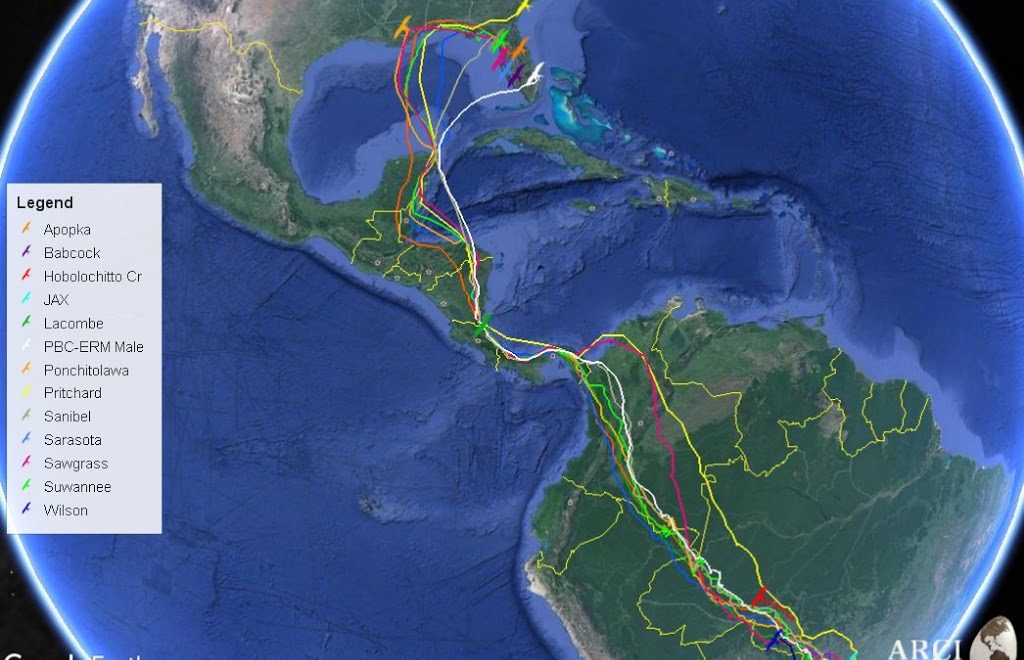
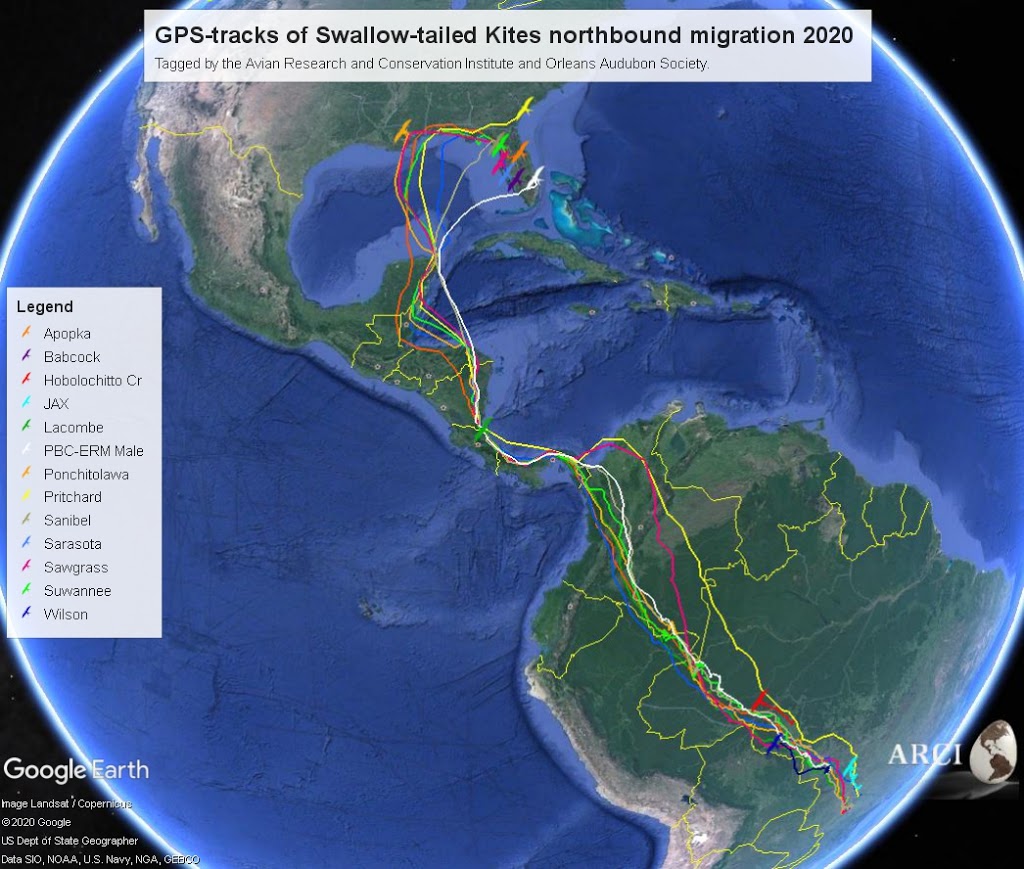
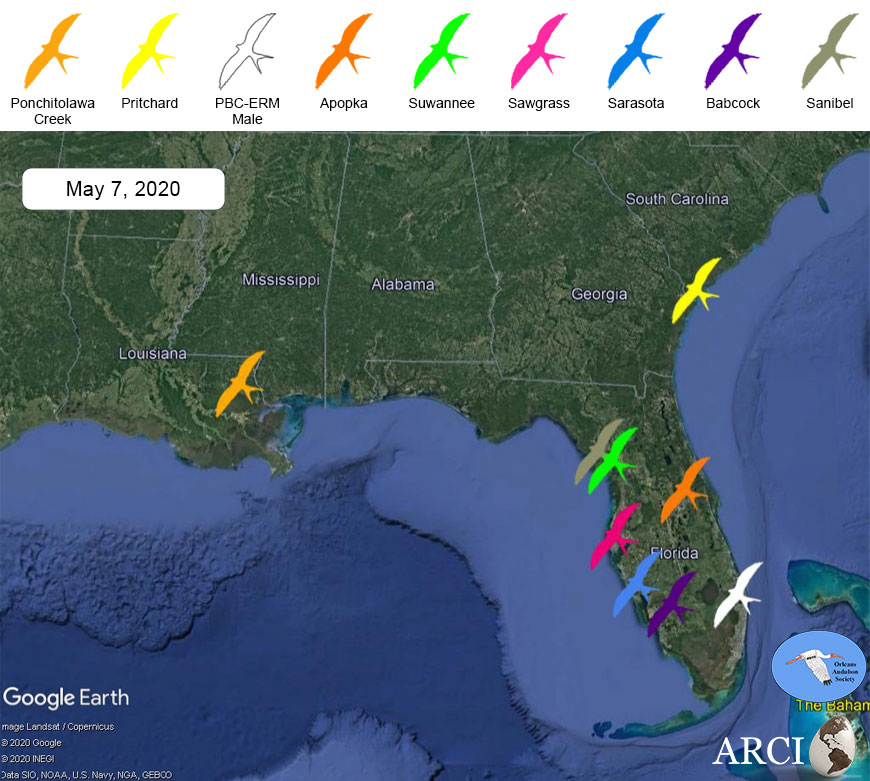
 Given ARCI’s small staff, and especially now with limited travel options, we are very grateful for our collaborator’s Eyes on Kites to help us monitor these GPS-tracked birds and other nesting kites on habitually used nesting areas.
 It is worth commenting here on the lifespan of the equipment we are now using to track Swallow-tailed Kites. Although cell-phone/GPS devices have storage batteries that repeatedly recharge via solar panels, these batteries, necessarily very small, can withstand only so many charge/recharge cycles before their stored energy is insufficient for transmission to cell towers (in our experience, lifespan has varied from about 1.5 to 3.0 years). The satellite/GPS devices we used more in the past last much longer (5.5 to 7.0 years), but they cost over three times as much per unit and tracking location.
 This last research need, which requires detecting when and where kites die, highlights the value of remotely tracking Swallow-tailed Kites. Human-induced changes in global climate regimes, the accelerating destruction of natural habitats by unsustainable economic and social conditions, and increasing applications of agricultural pesticides and herbicides harmful to wildlife are rapidly elevating the risks confronting the Swallow-tailed Kite’s U. S. breeding population all across their annual, 10,000-mile hemispheric range. Of particular concern are threats on their migratory and winter range– vast areas that lie beyond what we can observe and monitor directly. In the next two months, as we have periodically in the past, we will analyze all the satellite and cellular tracking data we have collected since 1996 to illuminate patterns in where and when mortality has occurred, and how these patterns may be shifting over time. What we learn will be posted on this site.
Audubon Center for Birds of Prey
bioGraphic
Caloosa Bird Club
Clearwater Audubon Society
CROW – Clinic for the Rehabilitation of Wildlife, Inc.
Florida Panther National Wildlife Refuge
Friends of Palmetto Bluff Conservancy
Friends of the Carlton Reserve
Friends of the Florida Panther Refuge
Friends of the Lower Suwannee & Cedar Keys National Wildlife Refuges
Halifax River Audubon
Jacksonville Zoo and Gardens
Lower Suwannee National Wildlife Refuge
National Audubon Society
Oklawaha Valley Audubon Society
Orange Audubon Society
Orleans Audubon Society
Palm Beach County Department of Environmental Resources Management
Palm Beach Zoo
Palmetto Bluff Conservancy
Peace River Audubon Society
Sanibel-Captiva Audubon Society
Sanibel-Captiva Conservation Foundation SCCF
Sarasota Audubon Society
Seminole Audubon Society
St. Petersburg Audubon Society
Sunrise Wildlife Rehabilitation
The Avian Reconditioning Center for Birds of Prey
Venice Area Audubon Society
West Volusia Audubon
Leave a Reply