
At the close of the 2020 Swallow-tailed Kite breeding season, when most kite families had already moved on from their nest sites to prepare for fall migration, ARCI succeeded in capturing and deploying a GPS backpack transmitter on an adult, Sanibel South, near its nest on West Gulf Drive on Sanibel Island, Florida. We are grateful for the enabling support of the Sanibel-Captiva Audubon Society and the family of the late Jim Griffith, whose boundless energy and generosity inspired and fueled so many successful conservation endeavors on Sanibel Island.
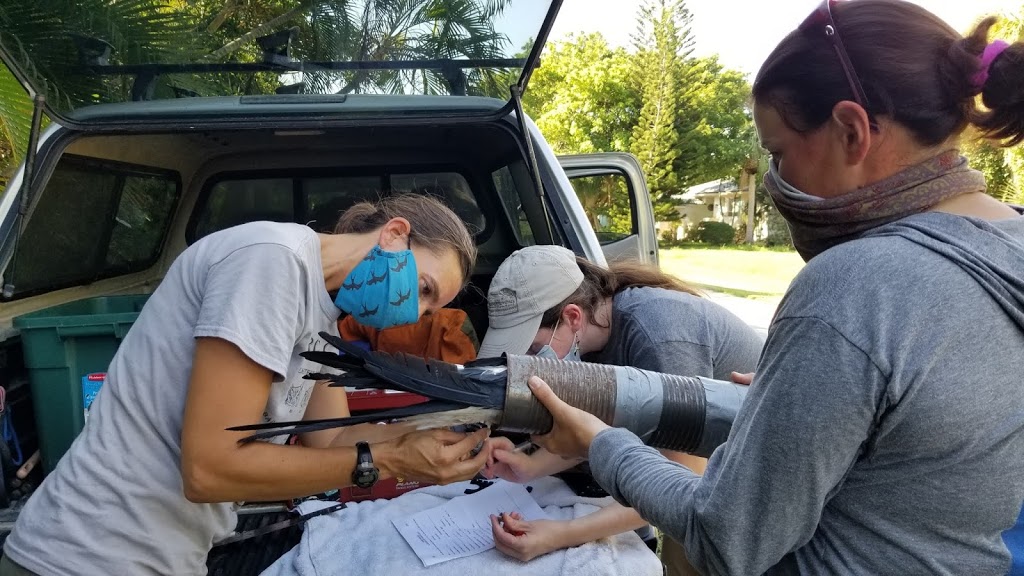 |
| Audrey Albrecht of SCCF holds a Swallow-tailed Kite in a protective can while Gina Kent of ARCI takes leg measurements and Amanda Wilkes of ARC records notes. Photo by Cheri Hollis |
At a different nest last year, but also in honor of Jim, ARCI tagged and began tracking a male Swallow-tailed Kite, named Sanibel. Although this bird proceeded to complete a full round-trip migration between Florida and its Brazilian winter range, his GPS data stream ceased in early March soon after he reached the Gulf coast of Florida’s Big Bend region. We have not been able to discern whether Sanibel died or his transmitter failed prematurely. Many able observers on Sanibel watched for a Swallow-tailed Kite carrying a transmitter near Sanibel’s former nesting territory. However, given the low profile and internal antenna of the tracking device he was carrying, Sanibel’sfate may remain a mystery.
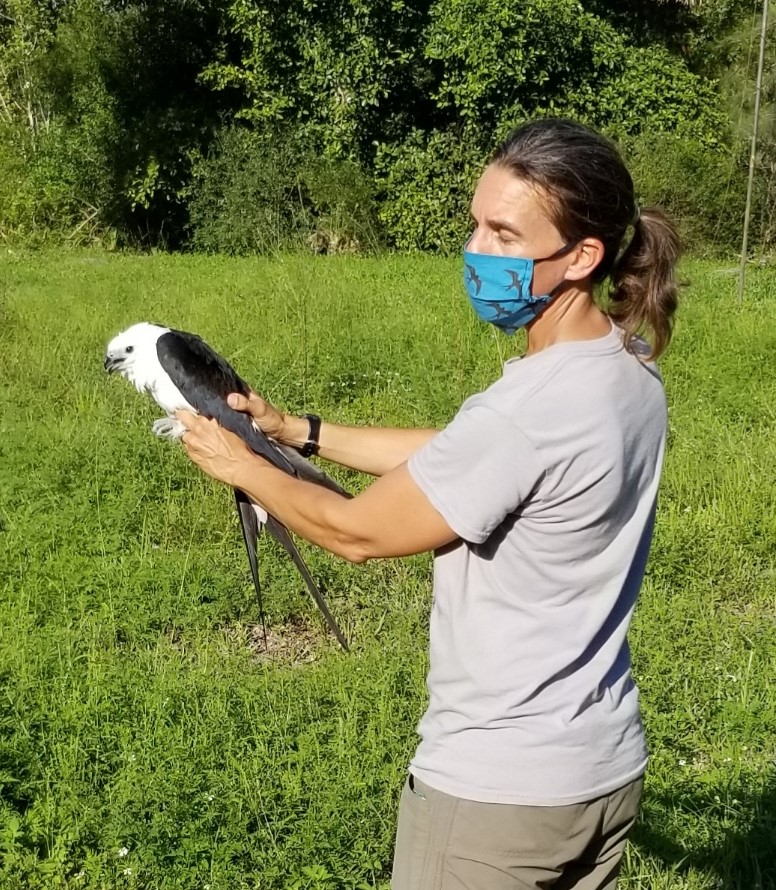 |
| Gina Kent of the Avian Research and Conservation Institute gets ready to release Sanibel South, a GPS-tracked Swallow-tailed Kite. Photo by Cheri Hollis. |
After successfully fledging two offspring, Sanibel South made her way inland to the ranch and farmlands west of Lake Okeechobee, in Glades County, Florida, where she began preparing for her southbound migration. However, rather than lingering there, she continued 220 miles north to Gilchrist County, Florida, where she spent her nights roosting along the Santa Fe River.
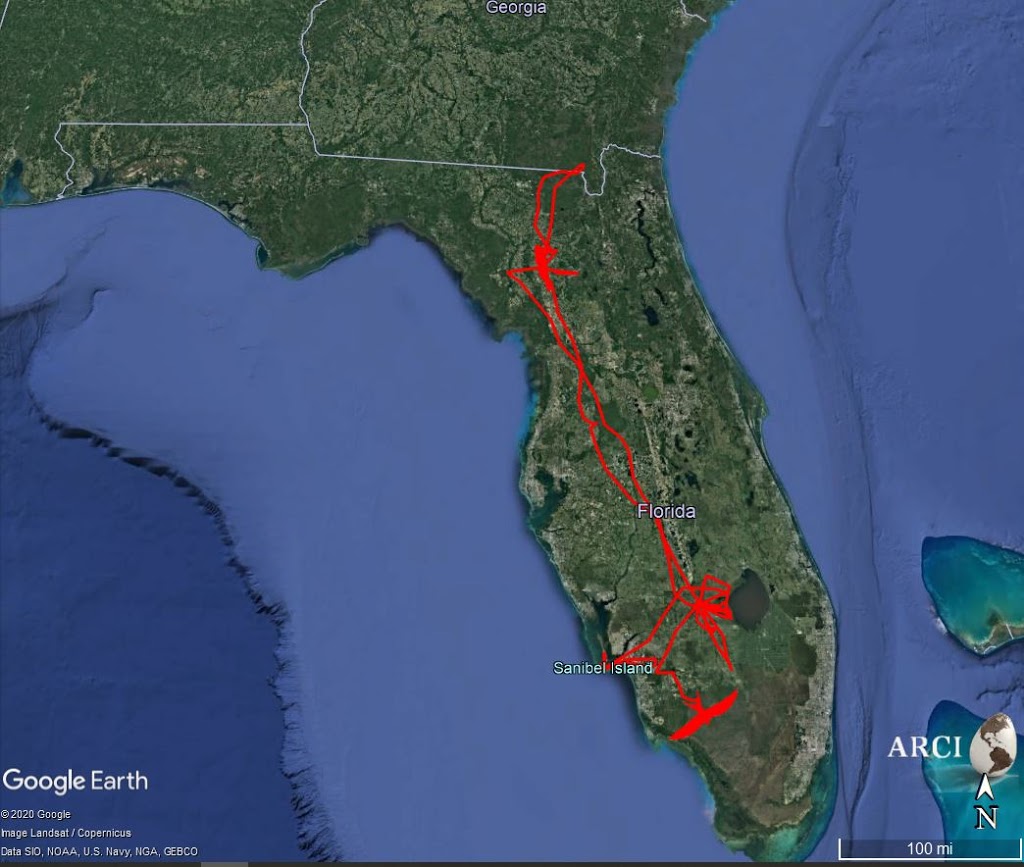 |
| Movement of Sanibel South, a Swallow-tailed Kite GPS-tracked by the Avian Research and Conservation Institute through July, 2020. |
Sanibel South stayed there for the better part of 20 days, apart from two interesting field trips. One was a 140-mile overnight venture to the St. Mary’s River (the Florida/Georgia state line) within the Okefenokee National Wildlife Refuge. The other trip was 23 miles due east of her Santa Fe roost to Gainesville, Florida, where she spent a night five blocks away from the ARCI office! The next day, she promptly backtracked to her Gilchrist County foraging area (although we didn’t get to thank her personally, we imagined her Gainesville visit a nice gesture).
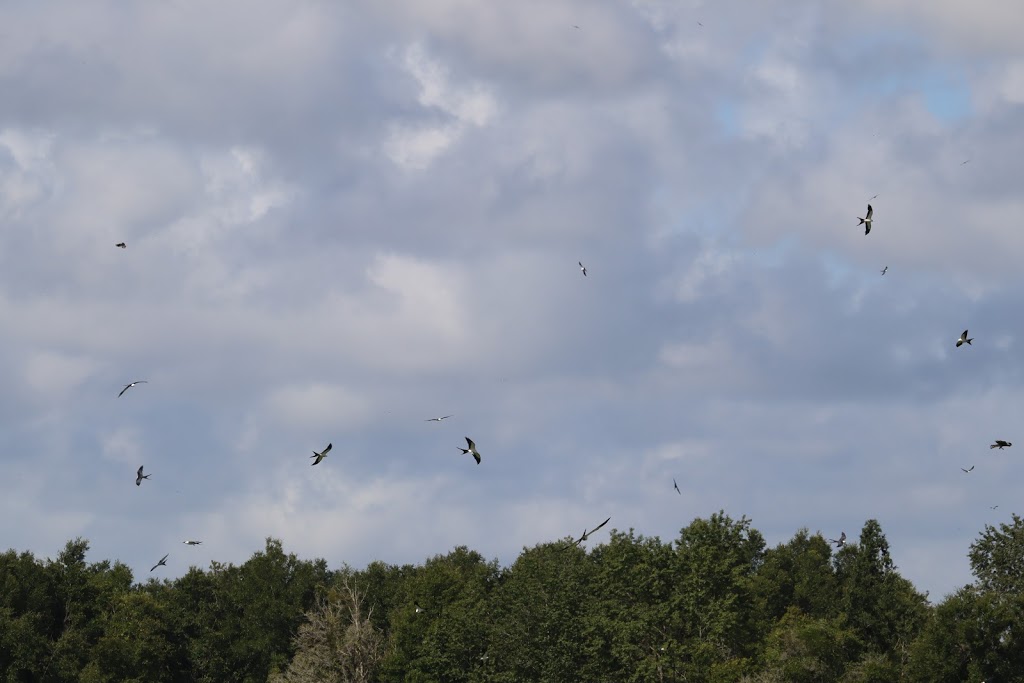 |
| Alachua County, Florida foraging aggregation of Swallow-tailed Kites over melon fields, July 2020. Photo by Adam Kent |
We had the opportunity this week to make a day trip to Sanibel South’s foraging area. To our great surprise, Sanibel was in the company of over 600 Swallow-tailed Kites!! These birds were taking advantage of the insects swarming over fallow fields, rotting watermelon crops, and small pine plantations along a busy county road – a Swallow-tailed Kite phenomenon that occurs sporadically at this time of year. Although we were unable to pick out Sanibel South, just knowing that she was in good company among the swirling masses of foraging kites and rapidly preparing for her imminent 5,000-mile migration gave us welcome piece of mind.
Sanibel South has since made a southward move into Collier County, Florida. We expect that she soon will be making her 400+ mile crossing over the Gulf of Mexico to pick up the traditional southbound, overland pathway of thousands of other Swallow-tailed Kites temporarily vacating their breeding range here in the southeastern United States. This is always a joyful-yet-sad time of year for us, all the more so as we remember Jim Griffith. However, with March likely to be here before we know it, and if we and the kites are all fortunate enough to be able to partake of another intoxicating southern spring, we can once again celebrate this glorious avian parable of nature’s inexplicable beauty and resilience.
Special thanks to Cheri Hollis, Audrey Albrecht of Sanibel Captiva Conservation Foundation, Amanda Wilkes and Nonamé the Great-horned Owl of the Avian Reconditioning Center, Phyllis Gresham and Debi Griffith, all for whom this research would not be possible.
fyi – on 4.24.22 I saw and photographed a swallow Tail kite w a transmitter on its back. the location of the sighting was apple pond on Sanibel island. Feel free to contact me if needed
Regards – Ken Maier
267-218-1995