
On 23 January 2021, a Swallow-tailed Kite called PBC-ERM Male started north from his wintering location in Mato Grosso, Brazil. He is the first to start northward among the 10 Swallow-tailed Kites that Avian Research and Conservation Institute (ARCI) is remotely tracking by GPS. As we have learned over the last 20 years of tracking northbound Swallow-tailed Kites, PBC-ERM is right on time for a first departure from the winter range.
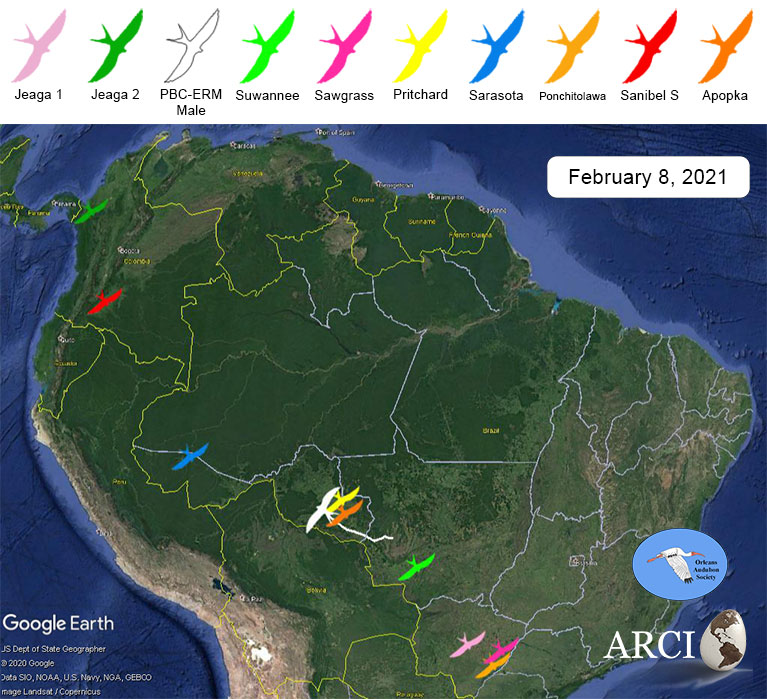
The other nine tagged kites remain on their wintering grounds in Brazil. Those that are the farthest south, in the Brazilian state of Mato Grosso do Sul, are Ponchitolawa, tagged by our colleague Dr. Jennifer Coulson in Louisiana; and Sawgrass, from Pinellas County, Florida. These two birds, which have been nesting 700 miles apart in the southeastern US, have been using the same roost site in southern Brazil, 5,000 miles away!
Sawgrass is our longest-tracked Swallow-tailed Kite carrying GSM (international cellular) technology. Her transmitter is archiving and re-transmitting GPS location data longer than expected, into her 5th recorded migration cycle. Jeaga #1 also is in Mato Grosso do Sul, 150 miles north of the others.
Suwannee and PBC-ERM Male had been using the same roost site in an area northwest of the city of Cuiabá in the state of Mato Grosso, Brazil. Apopka and Pritchard are wintering together in the state of Rondônia, Brazil. Pritchard last uploaded data at the end of September, perhaps because he is beyond cell-tower range. We are hoping his transmitter will send us all its stored data soon before its imminent expiration.
To recap, we are monitoring GPS locations of two US-breeding Swallow-tailed Kites in each of three habitually occupied roost sites spread over three states in Brazil. These six kites, 60% of our tracked sample, were tagged at nests distributed across the species’ entire US breeding range, from South Carolina to Louisiana. This unique information, amazing in itself, also serves as a striking reminder of how critically important gathering places are for Swallow-tailed Kites, including the foraging and resting areas, spread over the 5,000-mile migration corridor of the U.S. breeding population, that the birds have come to know and rely on over the years. We feel very fortunate to have this valuable tracking data, and we are very grateful to the many individuals and organizations who are making this research possible.
Three other Swallow-tailed Kites have been out of cell range for a few months; Sarasota last checked in from Acre, Brazil and both Sanibel South and Jeaga #2 last uploaded data in Colombia.
Of course, as amazing as this technology is, it remains imperfect. The cellular-data uploads from Swallow-tailed Kites on their winter range and during migration can be spotty due to a lack of cell coverage in remote areas. We sometimes go months without receiving data uploads, having to wait patiently for the birds to move within cell-tower range and upload all the GPS location data collected since the radio’s last transmission. This has become increasingly nerve-wracking over the last year as we have begun to see unusual deviations in routes, and even some unexpected mortality, during portions of the kites’ north- and south-bound migration that typically have been predictable and safe. We have to wonder if large-scale changes in climate conditions and the relentless accumulation of certain toxic agricultural chemicals (e.g., neonicotinoids, which have been proven to cause fatal disorientation in migrant songbirds) may be threatening Swallow-tailed Kites during their arduous 10,000-mile round trip annual migration.
Audubon Center for Birds of Prey
bioGraphic
Caloosa Bird Club
Clearwater Audubon Society
CROW – Clinic for the Rehabilitation of Wildlife, Inc.
Florida Panther National Wildlife Refuge
Friends of Palmetto Bluff Conservancy
Friends of the Carlton Reserve
Friends of the Florida Panther Refuge
Friends of the Lower Suwannee & Cedar Keys National Wildlife Refuges
Halifax River Audubon
Jacksonville Zoo and Garden
Lower Suwannee National Wildlife Refuge
National Audubon Society
Oklawaha Valley Audubon Society
Orange Audubon Society
Orleans Audubon Society
Palm Beach County Department of Environmental Resources Management
Palm Beach Zoo and Conservation Society
Palmetto Bluff Conservancy
Peace River Audubon Society
Sanibel-Captiva Audubon Society
Sanibel-Captiva Conservation Foundation SCCF
Sarasota Audubon Society
Seminole Audubon Society
St. Augustine Alligator Farm Zoological Park
St. Petersburg Audubon Society
Sunrise Wildlife Rehabilitation
The Avian Reconditioning Center for Birds of Prey
Venice Area Audubon Society
West Volusia Audubon
I moved to St.Augustine Fl. 10years ago. Fell in love with these extraordinary birds. We have fewer of them every year here. I do believe the destruction of every possible green space in this part of Fl is to blame. The over-development of St.John’s County is appalling. Feeding grounds for all our wildlife has been greatly impacted by touusands & thousands of houses & roads. These fabulous birds have less & less to feed on or places to nest. Utterly tragic for everyone & everything in this area.
Delighted to have our first spotting of the year on Feb 14, in Clearwater FL! One kite observed in the area of US 19 and Drew St. Can’t wait for them all to return!
Thank you ARCI for all you do! I also fell in love with these beautiful kites the first time I saw them. And yesterday I saw 2 flying low to the pines on the snake or lizard hunt in S. Ft. Myers.
Four have returned and were spotted by my wife over the Six Mile Cypress Slough!
Happy to have their return!
Four arrived in Dowling park Florida about a week ago and have returned each day so far to screech and circle over the river!
Hi All!
Our family saw an unusual bird swooping low, obviously on a hunting mission, for several minutes over the wheat fields of our farm! We weren’t quite sure of the breed, so I researched it. Swallowtail Kite! We live about an hour from the ocean, northern Outer Banks of eastern North in the small rural, farming community of Jamesville, NC
Really cool observation! You are on the northern limits of their breeding range. Let us know if you see more!
Saw a swallowtail kite today in Jacksonville, FL. Amazing birds!
I have seen 6 Kites in Hernando County on Mondon Hill Road near Bisner lake. Usually in the summer for several years
We have our first kite today at work in Lakeland,Fl across from Saddle Creek Park,looking forward to the season. They are so amazing,we usually have about a dozen here until July.
We now have 7 kites here at Saddle Creek Park in Lakeland, FL. They have such a journey it is nice seeing them return, you wonder how intense their trip must have been. Happy breeding and feeding to them. I just walk around looking up all season.
I saw my first ever Swallow tail kite a week ago. I was so impressed by its flying I immediately reached for my phone to take a video so I could look it up. Sure enough! It snagged a big bug in mid flight. I live near the marsh in Charleston, SC. Can’t wait to spot another!