
ARCI and Orleans Audubon Society (OAS) are tracking Swallow-tailed Kites not only to monitor the roosts, foraging areas, stopover sites, and winter destinations, but also to see how they use public and private lands throughout the Southeastern States. We are grateful to our funders and project partners for making this research possible.
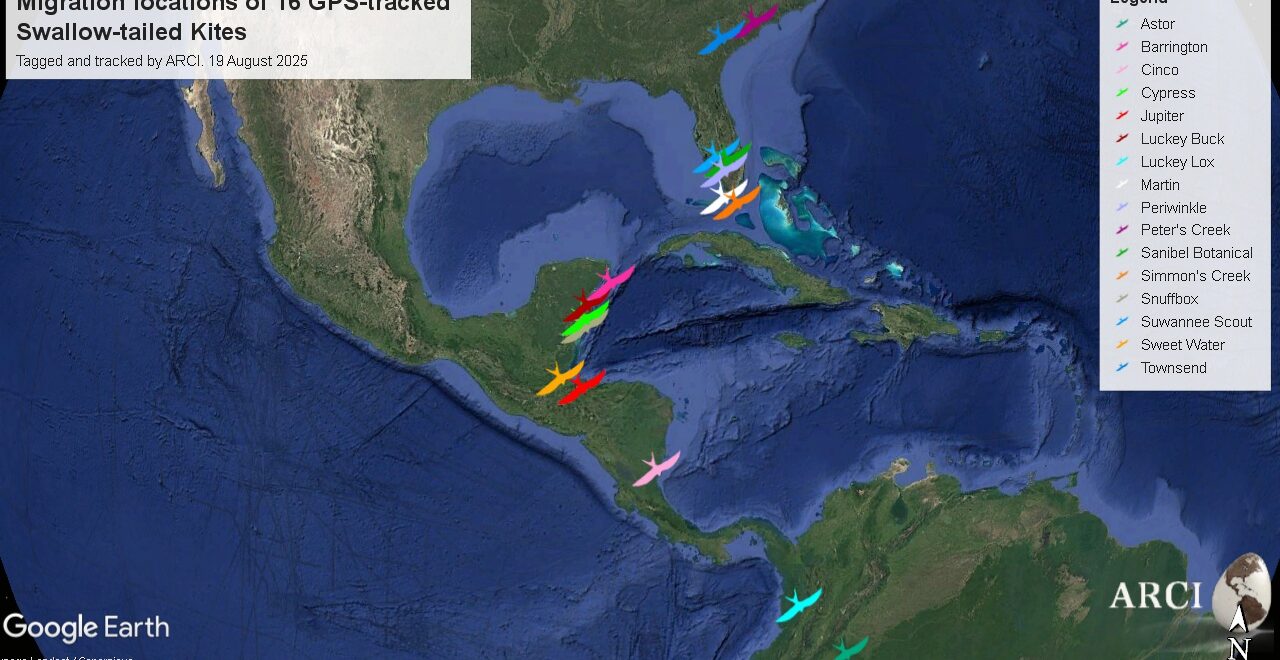
We are reporting on 16 kites tagged and tracked by ARCI
Sanibel Botanical: Female, tagged in 2021from Lee County, Florida. Currently one of the longest tracked GPS-tagged kites. She was last in Glades County, Florida on 27 July. Presumably she has made the flight to Central America and remains far from any cell towers to upload her data.
Periwinkle: Male, tagged in 2025, from Lee County, Florida was last in Collier County on 6 August, on a southbound track most likely on his way to cross the Gulf on his way to Mexico.
Cinco: Female, tagged in 2023 from Collier County, Florida last reported from Nicaragua on 1 August.
Suwannee Scout: Male, tagged in 2025, from Levy, County, has started south on 14 August and his last location was in Glades County on 16 August.
Astor: Female, tagged in 2025, from Lake County, Florida is the farthest from Florida, already safely crossed the Andes Mountains in Colombia.
Cypress: a male tagged in 2022, in Palm Beach County left Florida on 12 August from Cape Sable, north of the Florida Keys to the southwest, skirting around western Cuba and across Guanahacabibes before continuing to Cancun, Mexico. He is slowly making his way through Quintana Roo, Mexico.
Luckey Buck, a male tagged in 2025 in Palm Beach County, has also left Florida by way of the Everglades. It is quite likely that he was spotted by the Florida Keys Hawkwatch crew on 14 August around 4pm. The next morning, he crossed through western Cuba and out the Guanahacabibes Peninsula, west, coming ashore south of Playa del Carmen, Mexico. He is making his way south through Quintana Roo.
Luckey Lox, female, tagged in 2022, from Palm Beach County, Florida was the first GPS-tracked Swallow-tailed to leave Florida, last reporting from Paimado, Colombia just prior to crossing the Andes Mountains.
Martin a male, tagged in 2025, from Palm Beach County, left Florida on 3 August heading south from the Everglades National Park. Presumably she has made the flight to Central America and remains far from any cell towers to upload her data.
Jupiter a male tagged in 2025, from Palm Beach County, Florida, left the Everglades on 6 August and crossed the Seven-mile Bridge in the Florida Keys around 6:00pm and continued south to Cuba, spending a night in Las Terrazas before a southwest flight to Belize. Jupiter spent a seven-day stopover just 15 miles north of Belize City before continuing south, where he is now in Honduras.
Peter’s Creek: tagged in 2021, and Simmon’s Creek tagged in 2023, both from Georgetown County are still in South Carolina on the Great Pee Dee River. Both are northwest of their breeding area. Simmon’s Creek is about 20 miles north of Peter’s Creek.
Simmon’s Creek tagged in 2023, in Georgetown County, South Carolina made a bee line through Georgia and Florida from August 15 to 18, when he left the Everglades and crossed the Florida Keys around Lower Matecumbe Key around 1:00pm on 18 August. His last location was over the Straits of Florida.
Barrington: Male, tagged in 2023, from McIntosh County, Georgia spent pre-migration on the Altamaha River and started south through Florida on 12 August. On 16 August he flew south from the Everglades and across the Florida Keys 9 miles west of the Florida Keys Hawkwatch at Curry Hammock State Park at about 1:30 thus may have gone undetected. He spent two nights in Cuba before crossing west to the Island of Cozumel.
Snuffbox Canal: Male, tagged in 2023, from McIntosh County, Georgia, moved into central Florida in late July to spend some pre-migration time feeding and resting for the long migration. He started south again on 14 August and was crossing the Florida Keys west of Marathon around 1:00 on 16 August. He crossed through Cuba east of Havana and arrived in southern Quintana Roo on 18 August.
Sweet Water: Female, tagged in 2024, from Burke County, Georgia, made it safe to the Yucatan on 12 August after a slow headwind across the Straights of Florida to Cuba. She has continued south through Mexico and Belize and is on the Guatemalan coast.
Townsend: Male, tagged in 2025, from McIntosh County, Georgia has spent pre-migration between the Altamaha, Savannah, and North Fork Edisto Rivers in Georgia and South Carolina and is still on the Savannah River.
*All captures, banding, and tagging of Swallow-tailed Kites are done safely under current federal, state, and local permits.
Most of these Swallow-tailed Kites are being tracked through the GSM-cellular network thus, when they are not near cell towers, they cannot upload their data. They only attempt to upload data once a day to save battery power on their solar-powered units made by Cellular Tracking Technologies and Ornitela and during these big stretches over mountains, rainforest, and vast wilderness, they are far from a cellular connection. The location data is stored until they are within cell range to upload the stored data.
Wishing all Swallow-tailed Kites great tailwinds for a safe migration!
Keep tuned as we will be sharing updates on their migration to South America. Meanwhile, the 2025 Swallow-tailed Kite population monitoring survey period is currently taking place. We hope you will report where you are seeing kites to add “your” kites to the U.S. population count. That form can be found here.
This work would not be possible without our dedicated supporters and collaborators. For our current GPS-tracked Swallow-tailed Kites, we thank:
American Bird Conservancy (ABC)
The Avian Reconditioning Center for Birds of Prey
Barataria-Terrebonne National Estuary Program
Cellular Tracking Technologies CTT GSM-GPS transmitters
Florida Ornithological Society
Florida Panther National Wildlife Refuge
Friends of the Lower Suwannee & Cedar Keys National Wildlife Refuges
Friends of the Florida Panther Refuge
Lake Woodruff National Wildlife Refuge
Lower Suwannee National Wildlife Refuge
McDaniel Charitable Foundation
Merrit Island Wildlife Association
Microwave Telemetry, Inc. Satellite transmitters
National Fish and Wildlife Federation
Ornitela GSM-GPS transmitters
Palm Beach County Department of Environmental Resources Management
Palm Beach Zoo and Conservation Society
Parkside Elementary School, Collier Co. Florida
Sanibel-Captiva Audubon Society
Wow they are amazing birds and so fascinating…fun to watch-Thank you for all the work and updates.