
Nine GPS-tracked kites tagged to understand conservation value on private forest lands.
Avian Research and Conservation Institute (ARCI) and Orleans Audubon Society (OAS) have partnered with the American Bird Conservancy (ABC) on grants from International Paper (IP) and more recently, the National Fish and Wildlife Foundation (NFWF) titled: Birds: Ambassadors for Enhancing Conservation Value on Private Forest Lands. Together we are working with forestry companies like Resource Management Service (RMS), Forest Investment Associates (FIA), White Oak Forest Management, PotlachDeltic Corporation and many small private landowners to support the study of Swallow-tailed Kite habitat use in the southeastern United States.
This broad coalition consists of companies that purchase wood fiber, the landowners who actively manage their forests, and conservation organizations that provide expertise and guidance. The coalition is an excellent example of the cooperation and coordination needed to ensure our forests can support the future needs of wildlife, local communities, and the economy.
We are in our fifth year of tracking GPS-tagged Swallow-tailed Kites in the Southeastern US with this coalition. To understand the kites’ use of sustainable forests, locations from tagged kites will show their activity and locations within IP’s mill basins and we will be able to recognize their use of specific habitats for nesting, foraging, and roosting. These data will be critical to further improving the sustainable forest management techniques used by land owners that supply wood fiber to International Paper (more on Swallow-tailed Kite Forest Management Recommendations for Forest Owners). By successfully managing and creating nesting and foraging habitat conditions for the Swallow-tailed Kite, many other wildlife species that share the same habitat also will benefit.
*All captures, banding and tagging of Swallow-tailed Kites are done safely under current federal, state and local permits.
Migration updates: where are they now?
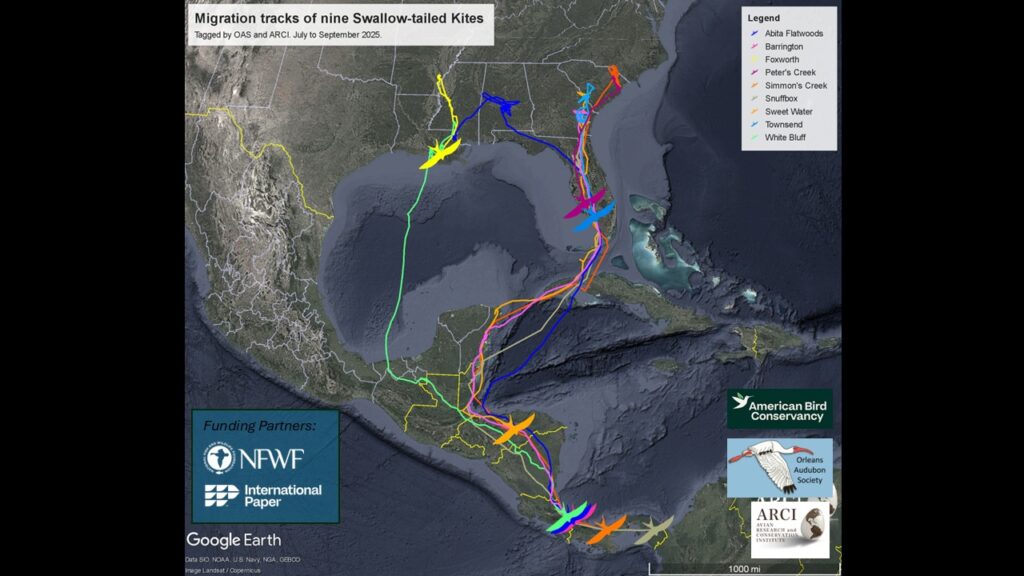
Six kites tagged by Avian Research and Conservation Institute in Georgia and South Carolina:
Peter’s Creek: Male, tagged in 2021, from Georgetown County, South Carolina. He stayed along the Great Pee Dee River in South Carolina for his pre-migration preparation and started south on 18 August and moved quickly through Georgia and Florida. His last location was the morning of 21 August near the Peace River south of Arcadia, Florida.
Simmon’s Creek: Male, tagged in 2023, from Georgetown County, South Carolina. Pre-migration was along the Great Pee Dee River in South Carolina, as well as north into North Carolina by Laurinburg. On 15 August, he started south through Georgia and Florida. He left for Cuba on 18 August and spent two nights there prior to crossing the Caribbean to Quintana Roo, Mexico. He last reported from western Panama.
Snuffbox Canal: Male, tagged in 2023, from McIntosh County, Georgia. In late July, he flew to central Florida to join a pre-migratory roost to prepare for migration for almost three weeks. He started south again on 14 August and flew to Cuba on 16 August. Currently, he is in eastern Panama and may be traveling with Simmon’s Creek since they both arrived in Panama.
Barrington: Male, tagged in 2023, from McIntosh County, Georgia. Barrington stayed along the Altamaha River near the Big Hammock State National Recreation Area for a month until heading south on 12 August and by 16 August he crossed to Cuba from Cape Sable, Florida. After two nights in Cuba and an additional night on Isla de Cozumel, he arrived in Quintana Roo, Mexico. Currently, he is in Costa Rica.
Sweet Water: Female, tagged in 2024, from Burke County, Georgia. By late June, Sweet Water was traveling along the Savannah River in Barnwell and Allendale Counties in SC and Burke and Screven Counties in GA. On 1 August, she spent 4 nights on the Altamaha River before heading to Florida. By 9 August, she took off south from the coastal Everglades, heading across the Florida Keys. The winds shifted to a headwind, and it was getting dark so she spent the night on Boot Key. Fighting the headwinds the following day, she pressed south to Cuba, arriving west of Havana in the middle of the night to rest for a few hours. With favorable winds the rest of the way, she arrived north of Cancun, Mexico on the night of 11 August and rested in northern Quintana Roo for three days. She last reported from central Honduras.
Townsend: Male, tagged in 2025 from McIntosh County, Georgia. Townsend was the last of the GPS-tracked Swallow-tailed Kites to start migrating. From his nesting area near the Altamaha River, he traveled north to the Savannah River, spending a month in pre-migratory prep before heading south on 27 August. He made his way to south Florida fast, where he last checked in from DeSoto County, Florida on 30 August.
Three kites tagged by Orleans Audubon Society in Louisiana and Mississippi:
Abita Flatwoods: Female, tagged in 2023, from St. Tammany Parish, Louisiana. She spent her pre-migration period near the Alabama River in central Alabama, just as she did in 2023 and 2024. She left central Alabama on August 11 to pursue the eastern Circum-Gulf migration route. She flew to the Florida panhandle and then flew south through the Florida peninsula. She launched off from the Everglades on August 17, crossing the Straits of Florida to spend the night near Havana, Cuba, on August 18. The following day, she crossed over Isla de la Juventud. Then she crossed the northwestern Caribbean Sea to make landfall in the state of Atlántida, Honduras. Her last known location was on August 24 from Costa Rica, in southeastern Limón Province, near the Panama border.
White Bluff: Male, tagged in 2024, from Marion County, Mississippi. He spent his pre-migration period near his breeding territory along the Pearl River. Then on August 10 he began his southbound migration, crossing into Louisiana. From August 11 through 13 he spent time in the Barataria-Terebonne Basin, and then he visited Attakapas Island in the Atchafalaya Basin. He departed the U.S. on August 18, exiting over the Wax Lake Outlet for a Trans-Gulf crossing, making landfall on August 20 in the state of Tabasco, Mexico. His last location on September 1 is from Costa Rica, in southeastern Limón Province, 5.5 miles from the Caribbean coast.
Foxworth: Male, tagged in 2025, from Marion County, Mississippi. He gave us a big surprise by flying to 220 miles north to southeastern Arkansas to spend his pre-migration period along the White River. He headed south from here on August 17, flying through Mississippi to south Louisiana. His transmitter last reported on August 20 from a large expanse of swamp in the Terrebonne Basin, Louisiana.
We are grateful to all the partners, organizations, and volunteers that have made this Swallow-tailed Kite research possible. A big thank you to EJ Williams of ABC for many hours of nest monitoring and trapping; Georgia DNR’s Andy Day, Erin Cork, and Tim Keyes for nest finding and tagging assistance; and additional assistance from Gianna Arcuri of ARCI.
Leave a Reply