
Townsend, a male Swallow-tailed Kite, was tagged with a GPS-tracker in June 2025 in McIntosh County, Georgia. Townsend was nesting on timberlands managed by the PotlachDeltic Corporation with a hunting easement through the Georgia Department of Natural Resources. This was the final capture and tagging effort for the 2025 breeding season for ARCI and their partners from the American Bird Conservancy (ABC) and Orleans Audubon Society (OAS). Funding and support was through a grant from the National Fish and Wildlife Foundation (NFWF) titled “Birds: Ambassadors for Enhancing Conservation Value on Private Forest Land” with additional funds from International Paper (IP). This initiative works with large companies and many small private landowners to support the study of Swallow-tailed Kite habitat use in the southeastern United States.
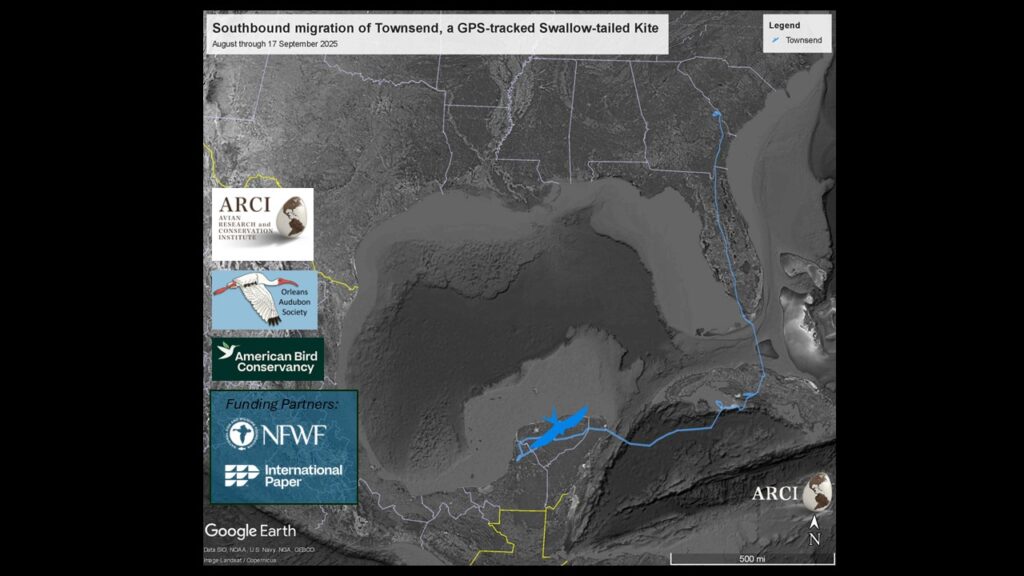
Townsend was the last to migrate of the GPS-tracked Swallow-tailed Kites tagged by ARCI. On 27 August, he started south from the Savannah River in Georgia. He spent the first night of his journey on the Altamaha River in a familiar area not far from his nesting territory.
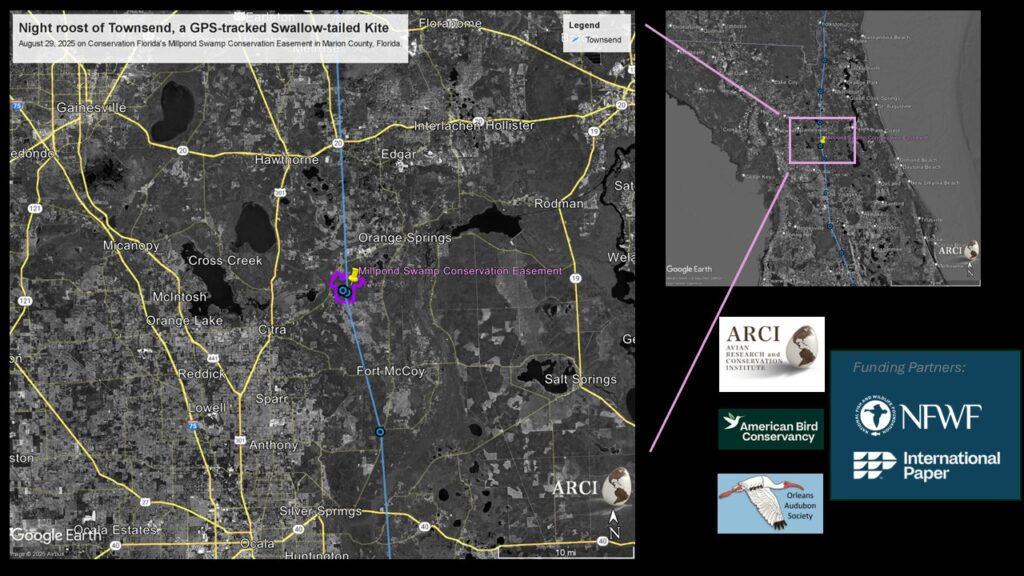
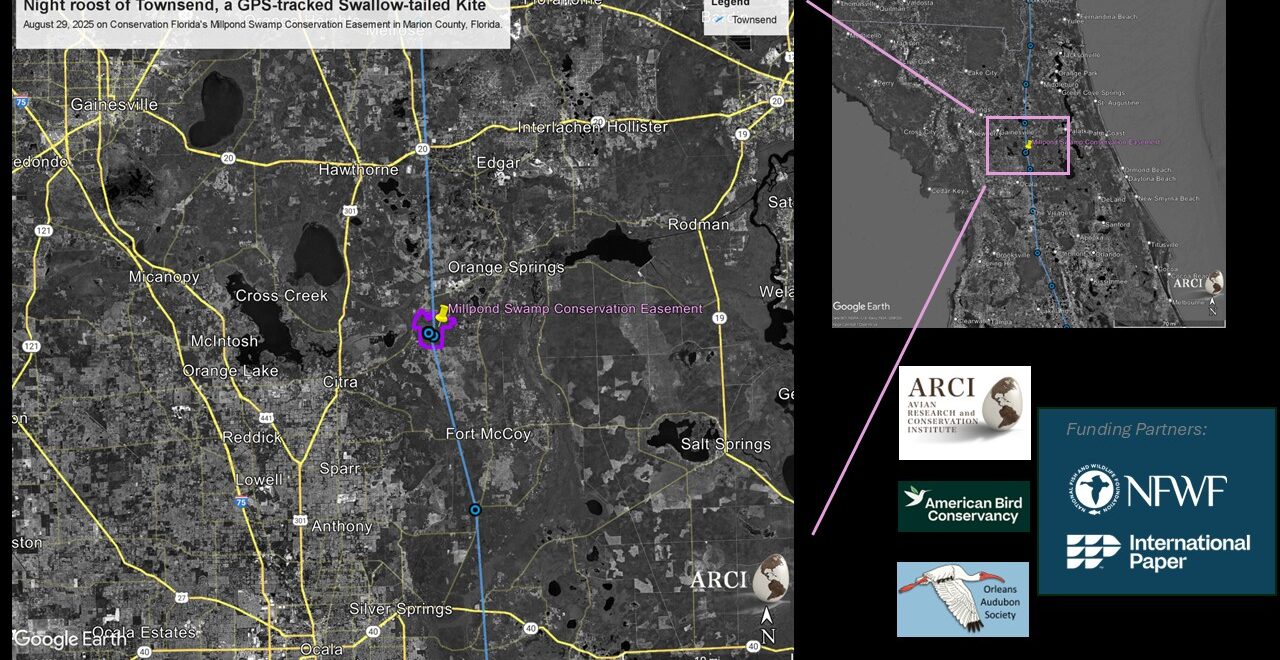
Continuing south to Florida, Townsend found a safe place to rest for the night in a conservation easement about 20 miles southeast of Gainesville in Marion County. This property is known as Millpond Swamp and managed by Conservation Florida. Lands like these are often purchased or set aside as important habitats and corridor links to protect biodiversity. These sorts of conservation lands are just what migrating birds like the Swallow-tailed Kite need for a rest or stopover.
By 1 September, Townsend was in Cuba, where he stayed four nights before flying to Cancún, Mexico. He remained in Mérida, Mexico for a few weeks, and we expect to hear from him on his southbound travels soon.
This work would not be possible without our dedicated supporters and collaborators.
American Bird Conservancy (ABC)
The Avian Reconditioning Center for Birds of Prey
Cellular Tracking Technologies CTT GSM-GPS transmitters
Georgia Department of Natural Resources (GADNR)
Microwave Telemetry, Inc. Satellite transmitters
National Fish and Wildlife Federation (NFWF)
Orleans Audubon Society (OAS)
Ornitela GSM-GPS transmitters
PotlachDeltic Corporation
Avian Research and Conservation Institute (ARCI) and Orleans Audubon Society (OAS) have partnered with the American Bird Conservancy (ABC) on grants from International Paper (IP) and, more recently, the National Fish and Wildlife Foundation (NFWF). Together we are working with forestry companies like Resource Management Service (RMS), Forest Investment Associates (FIA), White Oak Forest Management, PotlachDeltic Corporation and many small private landowners to support the study of Swallow-tailed Kite habitat use in the southeastern United States.
This broad coalition consists of companies that purchase wood fiber, the landowners who actively manage their forests, and conservation organizations that provide expertise and guidance. The coalition is an excellent example of the cooperation and coordination needed to ensure our forests can support the future needs of wildlife, local communities, and the economy.
We are in our fifth year of tracking GPS-tagged Swallow-tailed Kites in the Southeastern US with this coalition. To understand the kites’ use of sustainable forests, locations from tagged kites will show their activity and locations within IP’s mill basins, and we will be able to recognize their use of specific habitats for nesting, foraging, and roosting. These data will be critical to further improving the sustainable forest management techniques used by landowners that supply wood fiber to International Paper (more on Swallow-tailed Kite Forest Management Recommendations for Forest Owners). By successfully managing and creating nesting and foraging habitat conditions for the Swallow-tailed Kite, many other wildlife species that share the same habitat also will benefit.
*All captures, banding and tagging of Swallow-tailed Kites are done safely under current federal, state, and local permits.
Leave a Reply