
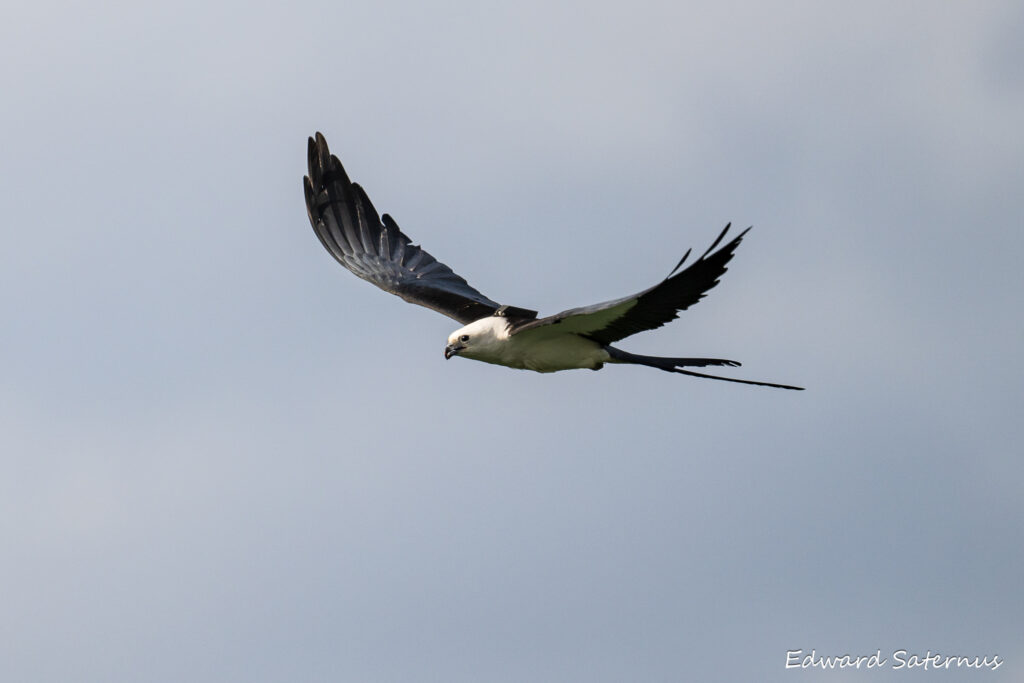
ARCI and Orleans Audubon Society (OAS) are tracking Swallow-tailed Kites not only to monitor the roosts, foraging areas, stopover sites, and winter destinations, but also to see how they use public and private lands throughout the Southeastern States. We are grateful to our funders and project partners for making this research possible.
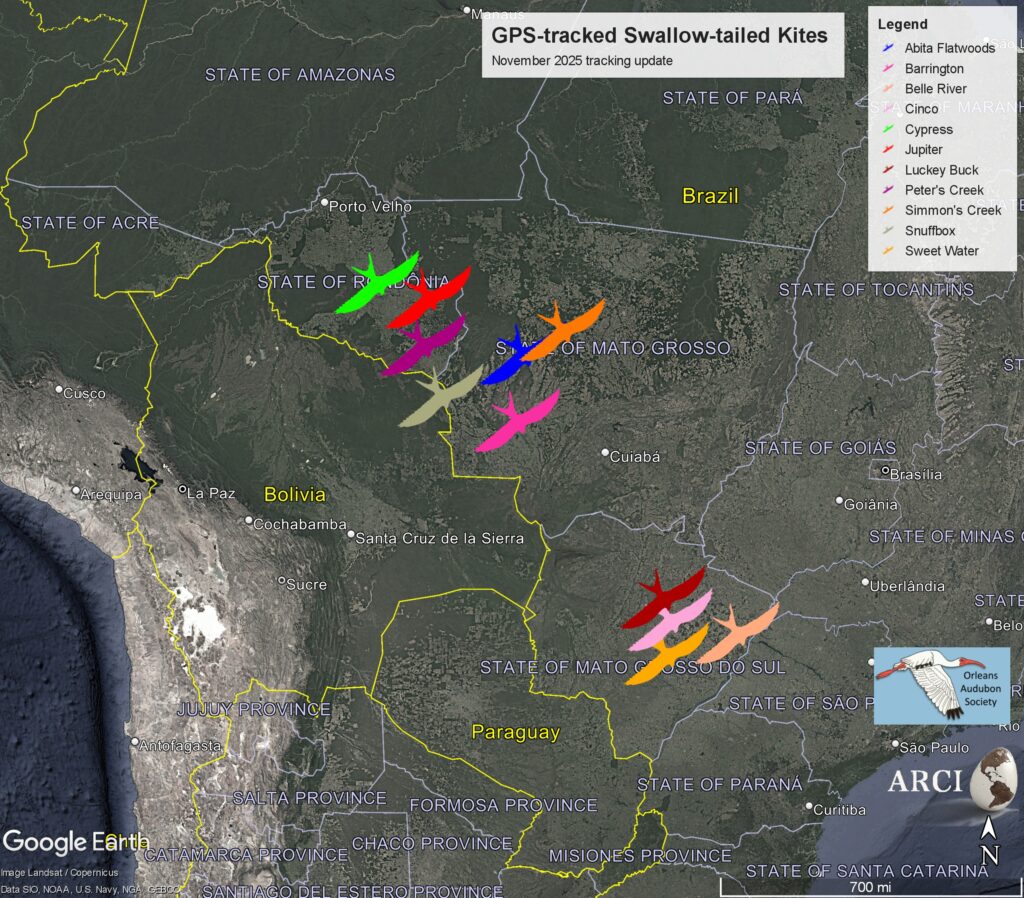
We are reporting on 20 Swallow-tailed Kites currently tracked by ARCI and OAS.
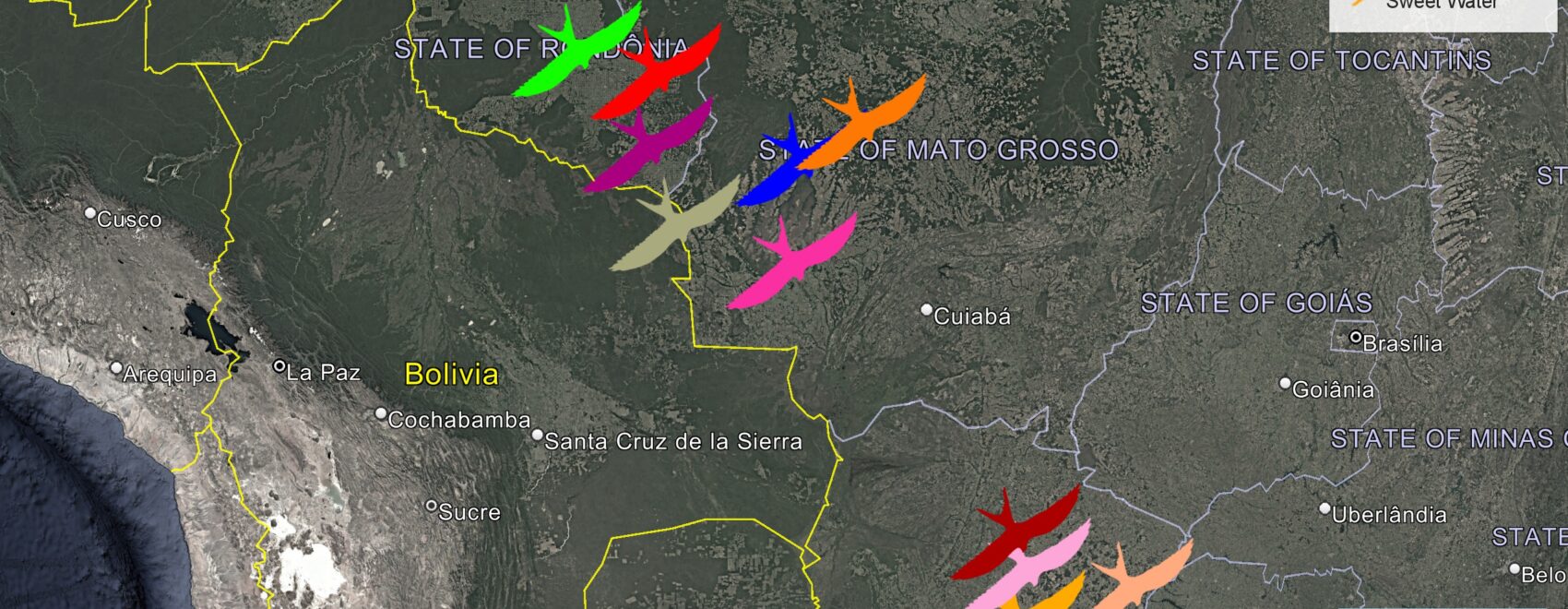
Jupiter a male tagged in 2025, from Palm Beach County, Florida, is spending time in Rondônia, Brazil in the same area as Cypress. Although they did not travel to Brazil together, these two Palm Beach County birds found the same wintering area.
Cypress: a male tagged in 2022, from Palm Beach County, Florida, is in Rondônia with Jupiter. They arrived in similar areas on the same day in September.
Peter’s Creek: a male tagged in 2021, from Georgetown County, South Carolina is also in Rondônia, Brazil about 70 miles south of Cypress and Jupiter.
Simmon’s Creek: a male tagged in 2023, in Georgetown County, South Carolina has settled into Mato Grosso, Brazil, since late September. About a month later, Abita Flatwoods from Mississippi joined him.
Abita Flatwoods: a female, tagged in 2023, from St. Tammany Parish, Louisiana took the southwestern route through Peru and Bolivia on her way to Mato Grosso, Brazil where she met up with Simmon’s Creek from South Carolina.
Snuffbox Canal: a male, tagged in 2023, from McIntosh County, Georgia has arrived on the Bolivian border from Mato Grosso, Brazil where he wintered last season.
Barrington: a male, tagged in 2023, from McIntosh County, Georgia is about 150 miles southwest of Snuffbox Canal in Mato Grosso, Brazil.
Townsend: a male, tagged in 2025, from McIntosh County, Georgia was the last of the GPS-tracked Swallow-tailed Kites to migrate. He spent a few weeks in Merida, Mexico and is currently crossing the Andes Mountains in Colombia.
Sweet Water: a female, tagged in 2024, from Burke County, Georgia, is in the same area as Belle River from Louisiana after they both spent time in Mato Grosso. They are now together east of Campo Grande, Mato Grosso do Sul, Brazil.
Belle River: a female, tagged in 2023, from St. Martin Parish, Louisiana, spent time in Mato Grosso Brazil and then continued farther south to a wintering area east of Campo Grande, Mato Grosso do Sul where she arrived just four days prior to Sweet Water from Georgia.
Cinco: a female, tagged in 2023 from Collier County. After spending over a month in Rondônia, Brazil, Cinco is now in Mato Grosso do Sul 70 miles west of Belle River and Sweet Water.
Luckey Buck: a male, tagged in 2025 in Palm Beach County, Florida, has also arrived in Mato Grosso do Sul, Brazil, just north of Campo Grande.
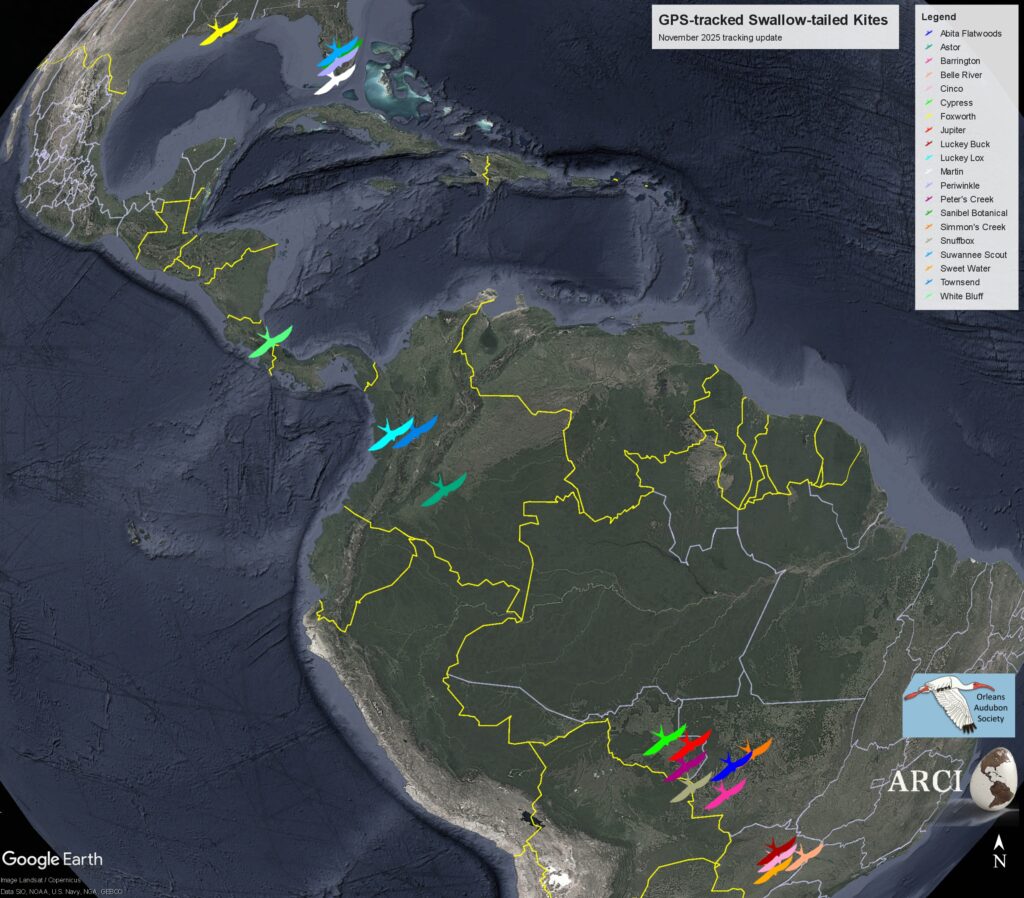
The following Swallow-tailed Kites have not uploaded location data for months. They presumably are in areas without cell coverage. Once they return within range of cell service, their transmitters will be able to transmit the stored data and location information. For now, we stay hopeful that they have indeed made it safely to their wintering grounds undetected.
Suwannee Scout: a male, tagged in 2025, from Levy County, Florida. His last location was in Glades County, Florida on 16 August.
Sanibel Botanical: a female, tagged in 2021, from Lee County, Florida. Currently, our longest tracked GPS-tagged kites. She was last in Glades County, Florida on 27 July.
Periwinkle: a male, tagged in 2025, from Lee County, Florida was last in Collier County, Florida on 6 August, on a southbound track prior to crossing the Gulf on his way to Mexico.
Astor: a female, tagged in 2025, from Lake County, Florida, last crossed the Andes Mountains in Colombia on 12 August.
Luckey Lox: a female, tagged in 2022, from Palm Beach County, Florida was the first GPS-tracked Swallow-tailed to leave Florida in 2025, last reporting from Paimado, Colombia just prior to crossing the Andes Mountains on 10 August.
Martin: a male, tagged in 2025, from Palm Beach County, left Florida on 3 August heading south across the Straits of Florida from the Everglades National Park.
White Bluff: a male, tagged in 2024, from Marion County, Mississippi, last reported on 1 September from Costa Rica.
Foxworth: a male, tagged in 2025, from Marion County, Mississippi, last reported near Houma, Louisiana prior to crossing the Gulf on 20 August.
*All captures, banding, and tagging of Swallow-tailed Kites are done safely under current federal, state, and local permits.
This work would not be possible without our dedicated supporters and collaborators. For our current GPS-tracked Swallow-tailed Kites, we thank:
American Bird Conservancy (ABC)
The Avian Reconditioning Center for Birds of Prey
Barataria-Terrebonne National Estuary Program
Cellular Tracking Technologies (CTT) GSM-GPS transmitters
Florida Ornithological Society
Florida Panther National Wildlife Refuge
Friends of the Lower Suwannee & Cedar Keys National Wildlife Refuges
Friends of the Florida Panther Refuge
Lake Woodruff National Wildlife Refuge
Lower Suwannee National Wildlife Refuge
McDaniel Charitable Foundation
Merrit Island Wildlife Association
Microwave Telemetry, Inc. Satellite transmitters
National Fish and Wildlife Federation
Ornitela GSM-GPS transmitters
Palm Beach County Department of Environmental Resources Management
Palm Beach Zoo and Conservation Society
Parkside Elementary School, Collier Co. Florida
Sanibel-Captiva Audubon Society
Thank you so much for your dedication to the beautiful creatures!