
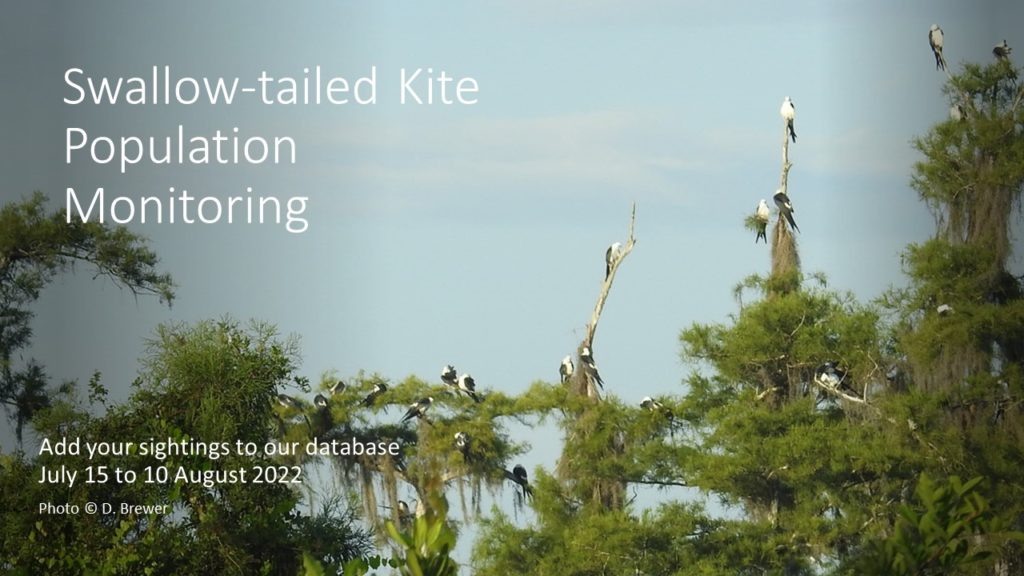
Every year since 1989, ARCI has conducted systematic aerial surveys to count Swallow-tailed Kites at more than 15 large pre-migration roosts in late July and early August. These roosts, some of which hold up to 4,000 birds, provide an extremely rare and valuable opportunity for long-term population monitoring of this population.
Pre-migration roosts are places where Swallow-tailed Kites gather for the night after their nesting responsibilities are over, but prior to departure on their southbound migration. These night roosts also serve as jumping-off points for daily foraging flights, for which Swallow-tailed Kites usually travel in small flocks. In these ways, individual kites benefit by having a safe place to sleep (more eyes and ears to detect predators) and also from what they can learn from each other about good foraging opportunities over the surrounding landscape, which may shift in location over periods of days and even hours. Knowing the most productive places to feed allows the kites to gain weight rapidly and prepare themselves for their imminent 5,000+ mile southbound migration, which begins with a very dangerous 450 to 600-mile flight over open ocean to Mexico’s Yucatan Peninsula.
From years of conducting these carefully designed aerial photo surveys, we are confident that we are probably counting most of the Swallow-tailed Kites that nest and hatch in Florida each breeding season, and at least two-thirds of the individuals associated with nests across the seven southeastern states that represent the current United States breeding range of this species.
However, we know that we are missing kites that are NOT using these large roosts as pre-migration staging areas. This is why it is so valuable to have YOUR help in counting Swallow-tailed Kites during this same time period (15 July to 10 August 2022).
Form to report Swallow-tailed Kites 15 July to 10 August 2022
Some of you may be able to see kites right in your neighborhood. Others may know of or suspect good observation locations within driving or paddling range, where you can search for roosting and foraging kites. It is best to locate and count the kites before 10am.
Please be extremely careful not to disturb or flush any roosting kites. Even one such intrusion might discourage individual kites from returning to a well-known and favored roost sight where they can sleep safely and, in effect, share information about productive feeding areas, which are critically important to their health and safety during the long over-water first leg of their arduous southbound journey. If any kites suddenly rise up in energetic flight, or even if they just call at you or seem to continually look alert in your direction, please assume you are too close and back off immediately.
To contribute to our growing community database of Swallow-tailed Kite sightings during this very special time of year please report the date, time, location, number, and behavior of kites you see with this 2022 Swallow-tailed Kite Population Monitoring Survey form. The form is responsive to your smart device, so you can even report from the field!
We are very grateful for your valuable help monitoring Swallow-tailed Kite population trends in 2022!
-The ARCI Team
Special thanks to the Palm Beach Zoo and Conservation Society and anonymous donors for funding our aerial roost surveys.
Saw two last week in Brunswick County N.C. Saw one in the Winnabow area and one in the Northwest area on the old DuPont site which is a wildlife conservation area. I’ve seen several at the old DuPont site over the years. I saw a group of three several years ago. I was in charge of the wildlife habitat program when the site was still in operation but it has been shutdown since 2013. I still do contract work for Dak America’s.
Thanks Mr. Young for the info on NC Swallow-tailed Kites. It seems they are doing better there in these recent years. I’ll check in to this location as I am not familiar with it. Appreciate you sharing your sightings.
Good morning!
We saw a huge colony of kites near Auburndale Florida area. There were at least 50 or maybe little more at the beginning of July. They leave that week. We assume that they are reunited with the others in some point to prepare for leaving Florida. My boyfriend and I are wildlife photographers and love to see them everywhere this time of the year!
Thanks for your report Ms. Astacio! Were you able to enter your sighting in our online database? Did you see the kites perched or foraging or both? Thanks again!
ONCE AGAIN I SAW A SWALLOW-TAILED KITE FLYING OVER THE ENTRANCE TO BROOKGREEN GARDENS LAST WEEK.