Why does ARCI want to track Swallow-tailed Kites? Based on our experience since 1996 with using satellites and cell-phone networks to follow kites, we know that each tagged Swallow-tailed Kite will produce an enormous amount of highly accurate, unbiased location data that can be used to address important questions about the species’ conservation biology, including: nesting locations, home-range and core activity areas, pre-migration communal roost sites, and seasonal movements. We tag kites in new populations and geographic locations to get a picture of kite movements range wide.
The technology: Since 2016, we have been using rapidly evolving, cutting-edge transmitter technology that uses cell tower networks to transfer location data to us. This new technology also allows us to send firmware updates to the transmitter after it is deployed on the birds so we can adjust the amount of data we receive based on the transmitter’s battery condition. These transmitters are very small and lightweight, so are safe for the birds. These transmitters are also affordable for our study objectives. This technology, however, can be tricky. Sometimes data doesn’t upload for days, weeks, or months because the kites are too far from the types of cell phone towers compatible for uploading data (3G, 5G, LTE, etc.). We know that if the kite makes it back safe to the U.S that we will receive all the stored GPS locations from the entire journey. We are hoping however, that the kites will pass near compatible towers at some point in South America so we can see their progress during the winter.
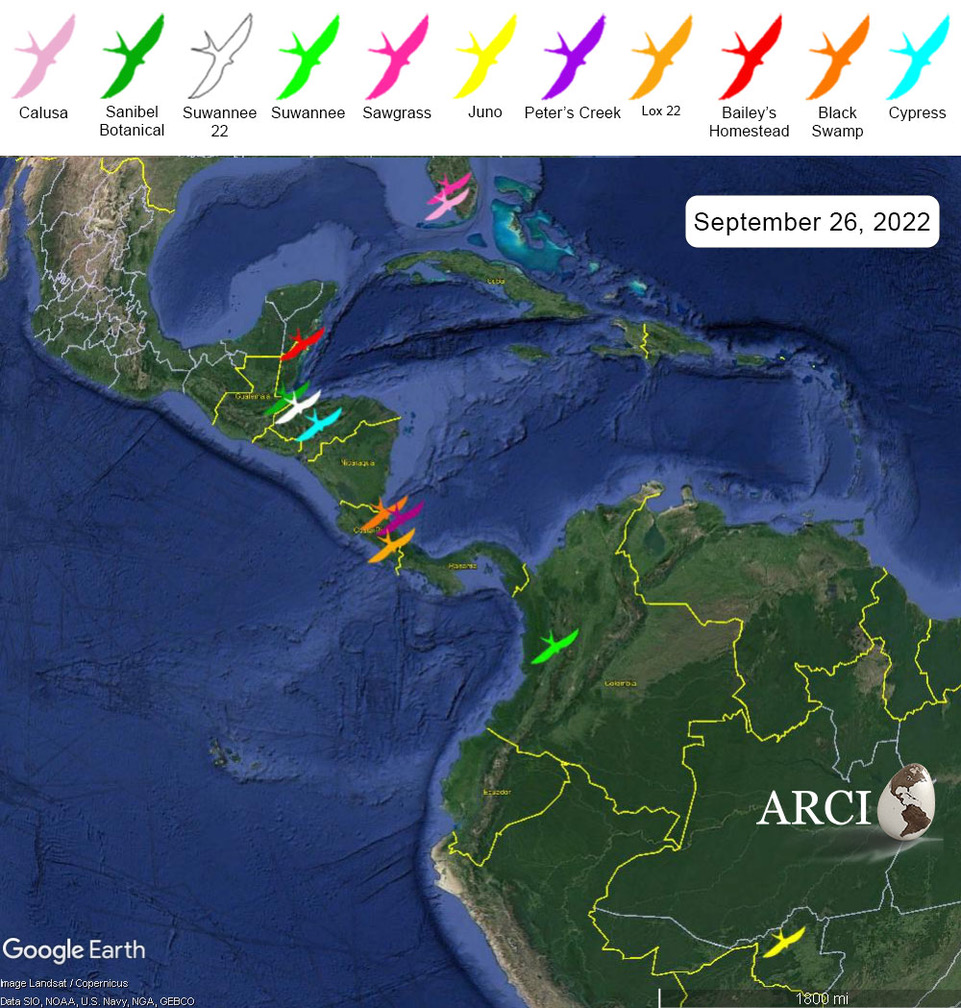
Look at Juno! This female from Palm Beach County, Florida was the first to upload locations from South America. She is in Rondônia, Brazil, a favorite wintering spot for kites.
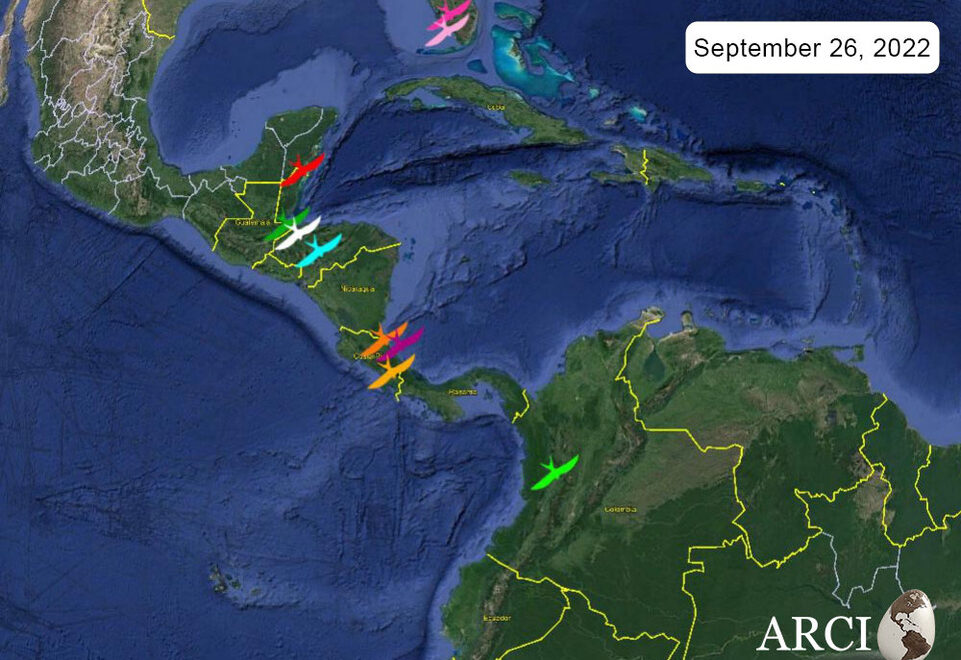
A kite named Suwannee, from Dixie County, Florida last uploaded data in Colombia while on his way to the Andes Mountains, an often a treacherous, high-altitude pass for migrating kites.
Three Swallow-tailed Kites last uploaded data from Costa Rica, near the Caribbean city of Limón. Lox 22 from Palm Beach County, Florida is a little farther south than Peter’s Creek and Black Swamp, both South Carolina kites.
Three other kites last uploaded data from Nicaragua where Cypress, from Palm Beach County, Florida lead the way. Suwannee 22, from Dixie County, Florida and Sanibel Botanical from Lee County, Florida were just a bit north.
Bailey’s Homestead from Lee County, Florida had a nice stopover rest in Quintan Roo, Mexico.
Two Swallow-tailed Kites last reported from Florida, but we have reason to believe that they are both well on their way to South America too. Sawgrass, from Pinellas County, Florida is presently our longest-tracked kite from 2016 and her transmitter is aging and may have quit while southbound through Florida on 14 August 2022. Calusa, a male from Collier County, Florida tagged in 2022, most likely slipped across the Gulf of Mexico in July before his transmitter could receive an update that would allow it to communicate with cell networks away from the U.S. We are not worried however, because he will store all those locations and be able to upload them when he returns to the U.S. next spring.
We expect very spotty data from these kites for the remainder of the winter as these birds fly deep into remote, mostly uninhabited areas where cell towers are scarce. Meanwhile we’ll just be crossing our fingers that they are safe.
Capturing these graceful fliers couldn’t be possible without the help of our Great Horned Owl friends who attract the kites to a large net. The four owls that have been instrumental in the capture of the 11 kites above are Trapper and Nonamé from the Avian Reconditioning Center in Apopka Florida, Hino from the Palm Beach Zoo and Conservation Society and Mina from the Clinic for the Rehabilitation of Wildlife (CROW).
We are grateful to our wonderful supporters that made this research possible. Thank you very much!
American Bird Conservancy (ABC)
bioGraphic
CROW – Clinic for the Rehabilitation of Wildlife, Inc.
Florida Panther National Wildlife Refuge
Forest Investment Associates (FIA)
Friends of Florida Panther National Wildlife Refuge
Friends of Palmetto Bluff Conservancy
Friends of the Lower Suwannee & Cedar Keys National Wildlife Refuges
International Paper (IP)
Lower Suwannee National Wildlife Refuge
National Audubon Society
Orleans Audubon Society
Palm Beach County Department of Environmental Resources Management
Palm Beach Zoo and Conservation Society
Palmetto Bluff Conservancy
Resource Management Service (RMS)
Sanibel-Captiva Audubon Society
Sanibel-Captiva Conservation Foundation SCCF
St. Augustine Alligator Farm Zoological Park
St. Petersburg Audubon Society
The Avian Reconditioning Center for Birds of Prey
White Oak Forest Management
Thank you for the update, Gina! Best wishes and high hopes for the tracked kites and all the other STKIs for a good winter and safe return to their breeding grounds. 🖤🤍🖤
Gina we met you at the Caloosa Bird Club where you gave a talk and told us all about putting transmitters on the swallowtail kites. After the talk we decided to donate money to finance one of the transmitters. Dick Brewer and myself volunteer for CREW and monitor the nests at Cypress Dome preserve for the last eight years.CALUSA is the bird that the transmitter was attached. We all were delighted to see that the bird was still alive because we hadn’t heard from it for over a year. Thanks for everything you do.😁👍❤️
Hi Rick and thank YOU for everything you do for Swallow-tailed Kites! I sure do remember meeting you and the Caloosa Bird Club’s support for the kite we named Okaloacoochee we tagged in 2018. The last we heard from him was in August of 2019 (Tracked a year and a half). This year we were back at the Florida Panther Refuge and tagged another kite we called Calusa. We would love the opportunity to continue to work around the CREW area with kites!
Einstein, from Sunrise Wildlife helped capture Suwanee. He has passed on, and we miss him every day.
Thanks Joe and thank you Einstein! We couldn’t do our research without ambassador owls like him. He will be missed.