
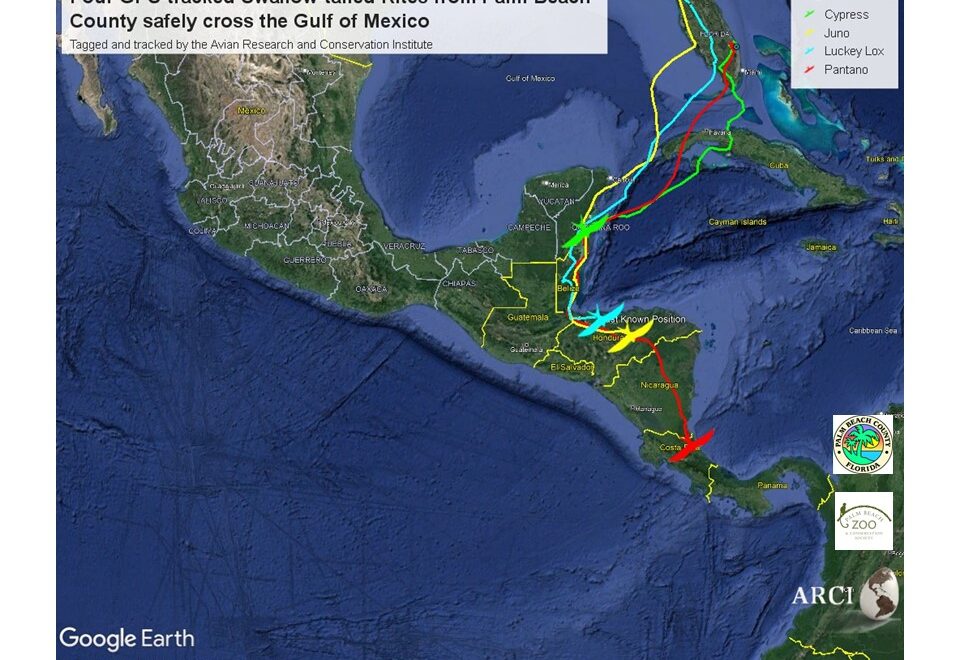
Migration can be difficult, unpredictable, and life-threatening especially when landbirds must cross large bodies of water (like the Gulf of Mexico) and can’t rest or eat until they reach dry land.
We are delighted to report that the four Swallow-tailed Kite we are tracking in partnership with the Palm Beach Zoo & Conservation Society and Palm Beach County’s Department of Environmental Resources Management (ERM) have “landed” on dry land.
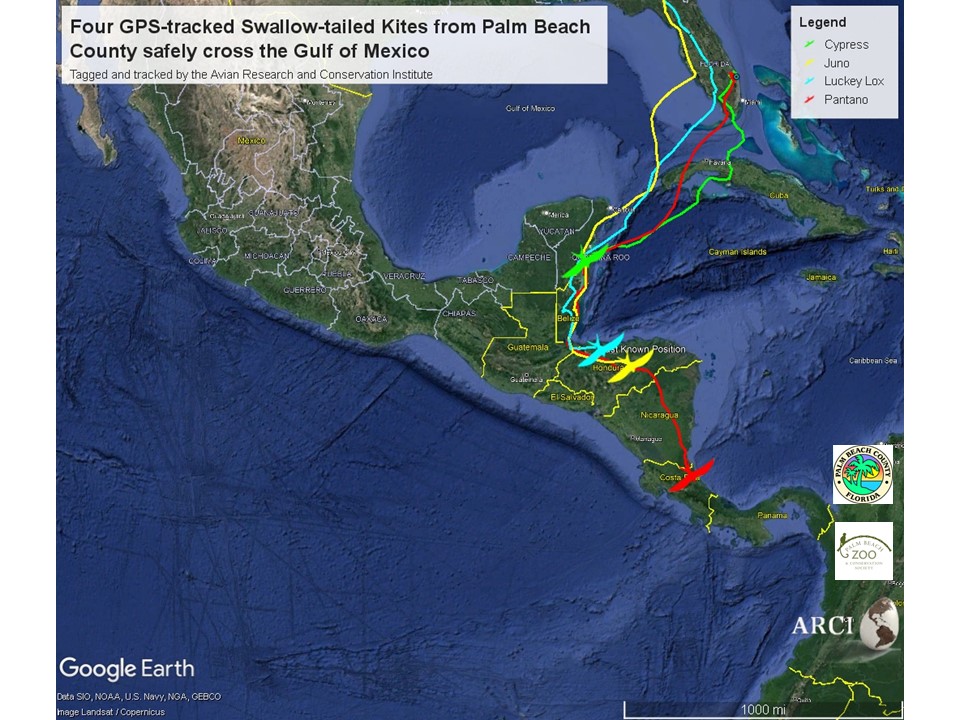
If you recall from our July blog, Luckey Lox, a female tagged in 2023, was the first GPS-tracked Swallow-tailed Kite to leave the U.S.A on 14 July. She flew across the Gulf of Mexico and passed the west tip of Cuba, making landfall in Quintana Roo, Mexico. She found a 12-day stopover site in the Tapir Mountain Nature Reserve in central Belize then continued south along the coast of Honduras. Her last location was on 31 July. We hope she is just scooting through Central America missing the necessary cell tower connection to upload her data.
In late July, Juno, a female tagged in 2022, went to the Altamaha River near Abbeville, Georgia to prepare for migration. Once ready, she started south on 15 August, clinging to coastal Florida along the Gulf of Mexico and heading across the Gulf two days later from Charlotte County, Florida. She did not rest before crossing and instead took off over the Gulf at 03:00 in the morning. We rarely see kites leave land in the middle of the night! Furthermore, she also skipped resting on the western tip of Cuba when passing in the middle of the night, continuing her over-water flight to Quintana Roo, Mexico, and even while over land, she continued flying another 130 miles until nightfall! She must have had an incredible tailwind that was too hard to resist! Her effort exemplifies migration preparedness to the finest; being in good condition with the energy reserves to power through and beyond. In three days’ time, she flew at least 920 miles without landing. Juno last reported from northern Honduras on 22 August.
Pantano, a female tagged this year and Cypress, a male tagged in 2022 stayed close to Palm Beach County ERM properties and protected lands for their pre-migration preparation.
On 11 August Pantano moved south, spending one night in the Florida Everglades. She cut south across the Florida Keys, perhaps being counted by the Florida Keys Hawkwatch crew (between 13:00 and 14:00) on 12 August before continuing across western Cuba (non-stop through the night!). She arrived at Quintana Roo’s Sian Ka’an Biosphere Reserve and had a safe place to rest before continuing south. Her last location was on 22 August from Costa Rica.
Cypress left Palm Beach County Florida on 18 August and spent one night in Collier County before a south-southeast track towards Cuba. He passed over Cuba near Santa Marta and down through the Zapata Swamp before spending a night on a tiny Cay 7 miles west of “the toe”. Since 22 August, Cypress has been stopping over (rest and refuel) in the same area of the Sian Ka’an Biosphere Reserve that Pantano was in 8 days prior.
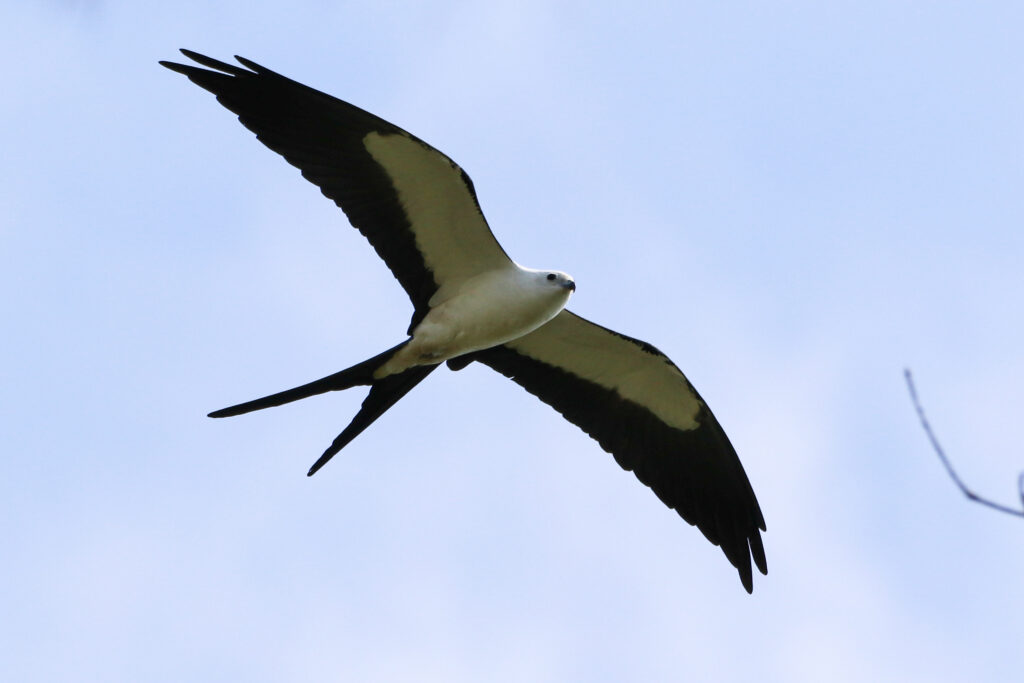
ARCI is tracking Swallow-tailed Kites not only to monitor the roosts, foraging areas, stopover sites, and winter destinations, but also to see how they use public and private lands throughout Florida and other Southeastern States. We are grateful for our funders and project partners for making this research possible.
Palm Beach Zoo & Conservation Society, in conjunction with long-time Zoo sponsor Florida Power & Light Company, have generously provided funding for the solar-powered GSM-GPS transmitters needed to continue this vital conservation effort.
Hey Gina thanks for these fantastic conservation efforts you share.
Suwannee??
anything?
Looking forward to future migrations and generations!
💙💙💙 these amazing Raptor’s!
Denise Johnson
Fernandina Beach Fl
Thank you so much for these updates. Juno’s migration is an incredible feat.