
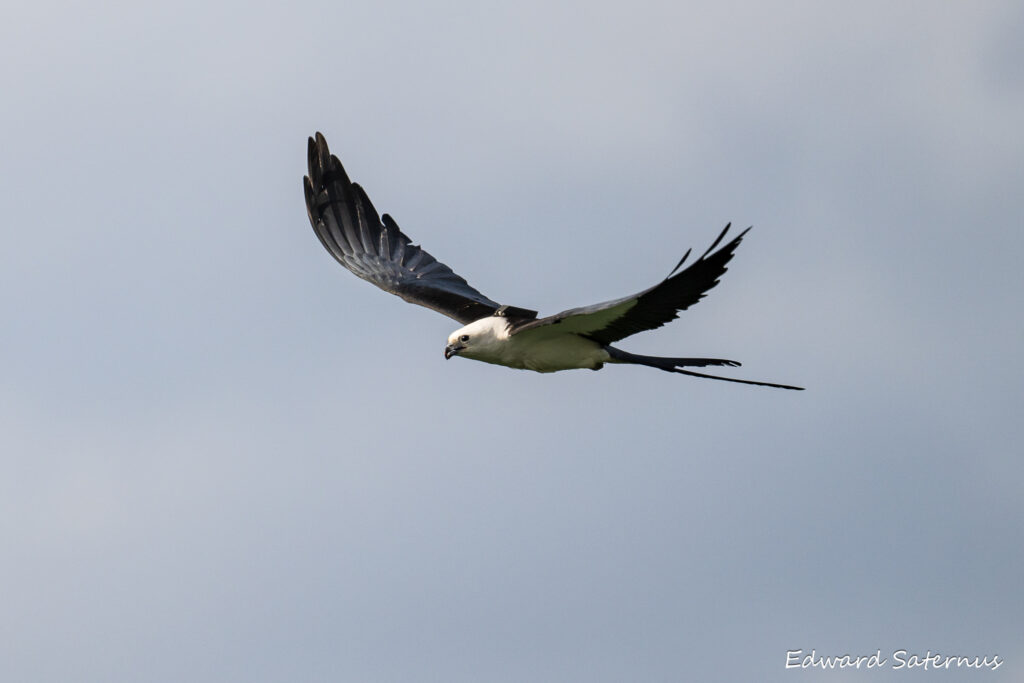
The following update includes 14 GPS-tracked Swallow-tailed Kites ARCI has tagged in Florida, Georgia, and South Carolina as well as four Kites tagged by our partners at Orleans Audubon Society in Louisiana and Mississippi, all through various projects, partnerships, and funding. These birds were tagged from 2021 to 2024.
“Missing” GPS-tracked Swallow-tailed Kites
Some birds have not uploaded data for almost 90 days. Most of these Kites are being tracked with the GSM-cellular network, and when they are not near cell towers, they cannot upload their data. During lengthy stretches over mountains, oceans, and vast wilderness, they are far from a cellular connection. We hope this is the case with our “missing” birds and that once they reach a place with cell coverage, they can connect and upload all their stored location data.
Crescent, a female from Jasper County, South Carolina was last in south Florida on 1 August and has not uploaded data since. We will remain optimistic that she will get to an area with cell coverage soon.
White Bluff, a male from Marion County, Mississippi and Pantano, a female from Palm Beach County, Florida are two kites we have not reported since they were in Costa Rica in August. Trailing behind them in Honduras is Silver Creek, a juvenile female released in Marion County, Mississippi, who migrated over land and around the Gulf of Mexico. This bird last uploaded data in early October.
Cinco was with Pantano and White Bluff when they last transmitted from Costa Rica. Cinco recently checked and apparently is safe in Brazil.
Swallow-tailed Kites in Brazil
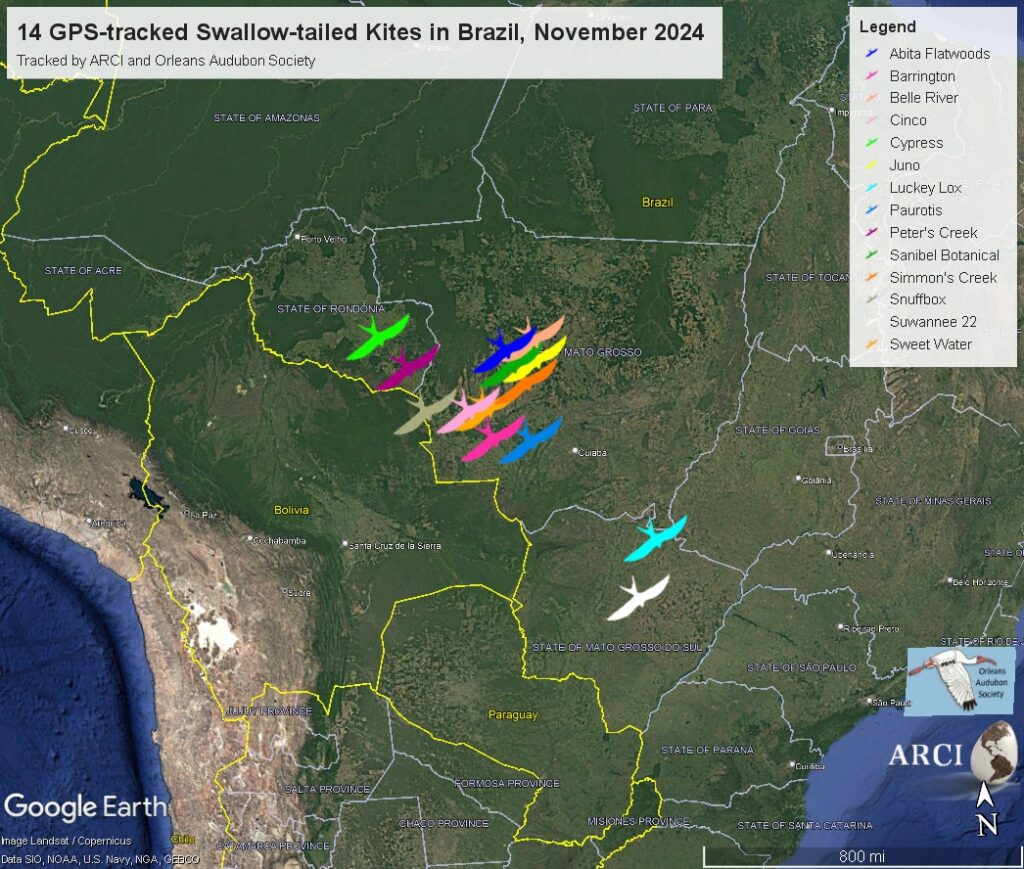
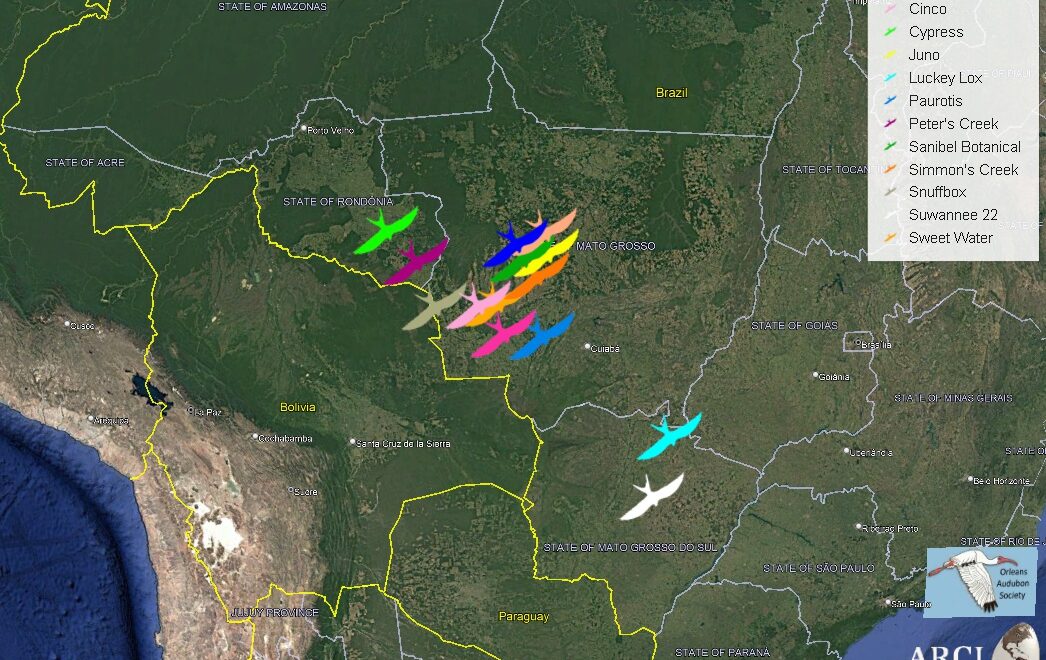
Remember Suwannee 22, the female from the Lower Suwannee National Wildlife Refuge in Levy County, Florida that had a second chance at crossing the Gulf of Mexico after Hurricane Debby? She sped past all other migrating GPS-tracked kites and is now the farthest south, in Mato Grosso do Sul, Brazil. Luckey Lox, a female from Palm Beach County, Florida is also in Mato Grosso do Sul just 130 miles north of Suwannee 22.
Two Swallow-tailed Kites are in the State of Rondônia, Brazil: Cypress, a male from Palm Beach County, Florida is only 85 miles north of Peter’s Creek, a male from Georgetown County, South Carolina who was the last of the GPS-tracked Swallow-tailed Kites to cross the Gulf of Mexico.
Ten GPS-tracked Swallow-tailed Kites are in the western part of the State of Mato Grosso, Brazil. All are within a 200 sq mile area. Some birds are IN THE SAME roost trees!
Paurotis, a female from the Florida Panther National Wildlife Refuge is the farthest south and Barrington, a male from McIntosh County, Georgia is following in her “wing beats” and spending time in the same areas south of Aldeia Zamaicara. The Abita Flatwoods female, from St. Tammany Parish, Louisiana was also in this area for a while but diverted 150 miles north in mid-October. She is now in the company of a five other GPS-tracked kites from our U.S. study population.
Abita Flatwoods iswith Simmon’s Creek, a male from Georgetown County, South Carolina; Juno, a female from Palm Beach County, Florida; Sanibel Botanical, a female from Lee County, Florida; and Belle River, a female tagged in Assumption Parish, Louisiana. They are weaving between forests and agriculture in a 70-mile diameter circle near Capanema, Mato Grosso. They’ve shared roosts and foraging locations in this tiny locus of South America, all coming from distant breeding locations in south Florida, coastal South Carolina, and southern Louisiana. Just think of how many other Swallow-tailed Kites might be with them!
Another 100 miles southwest, Sweet Water, a female from Burke County, Georgia and Cinco, a female from the Florida Panther National Wildlife Refuge Florida are utilizing areas around Paresi, Mato Grosso.
Snuffbox Canal, a male from McIntosh County, Georgia appears to be roosting on the Bolivian border by night and feeding in Mato Grosso by day.
ARCI and OAS are tracking Swallow-tailed Kites not only to monitor the roosts, foraging areas, stopover sites, and winter destinations, but also to see how they use public and private lands and survive throughout the Southeastern States. We are grateful for our funders and project partners for making this research possible.
Leave a Reply