
The Avian Research and Conservation Institute has been tracking Swallow-tailed Kite migration since the 1990s. One of the kites, an adult female named Cinco, was tagged at the Florida Panther National Wildlife Refuge in 2023. We are tracking her third migration. She was the second of 20 GPS-tracked Swallow-tailed Kites ARCI and Orleans Audubon Society are currently tracking from Southeastern U.S. States.

If you recall Cinco’s precarious journey back to Florida for the breeding season last March, you will remember that she flew about 114 hours up the Atlantic Ocean to South Carolina on crazy tailwinds. This route took her way off course from the standard migration path across the Gulf within the safety net of the Florida peninsula and other Gulf states. Somehow, she knew to change course and fly southwest back to land. See our March blog.
Despite the long, arduous trip, she was fit and punctual enough to make her way south from South Carolina and secure a territory and raise chicks once again at the Florida Panther National Wildlife Refuge. This area is a stronghold for kite nesting, with as many as 15 nests likely within a few miles of Cinco’s nest.
Once she finished nesting, she flew north to Lake Okeechobee in Glades County, Florida where she fed on insects for weeks, allowing her to put on weight for the flight to South America.
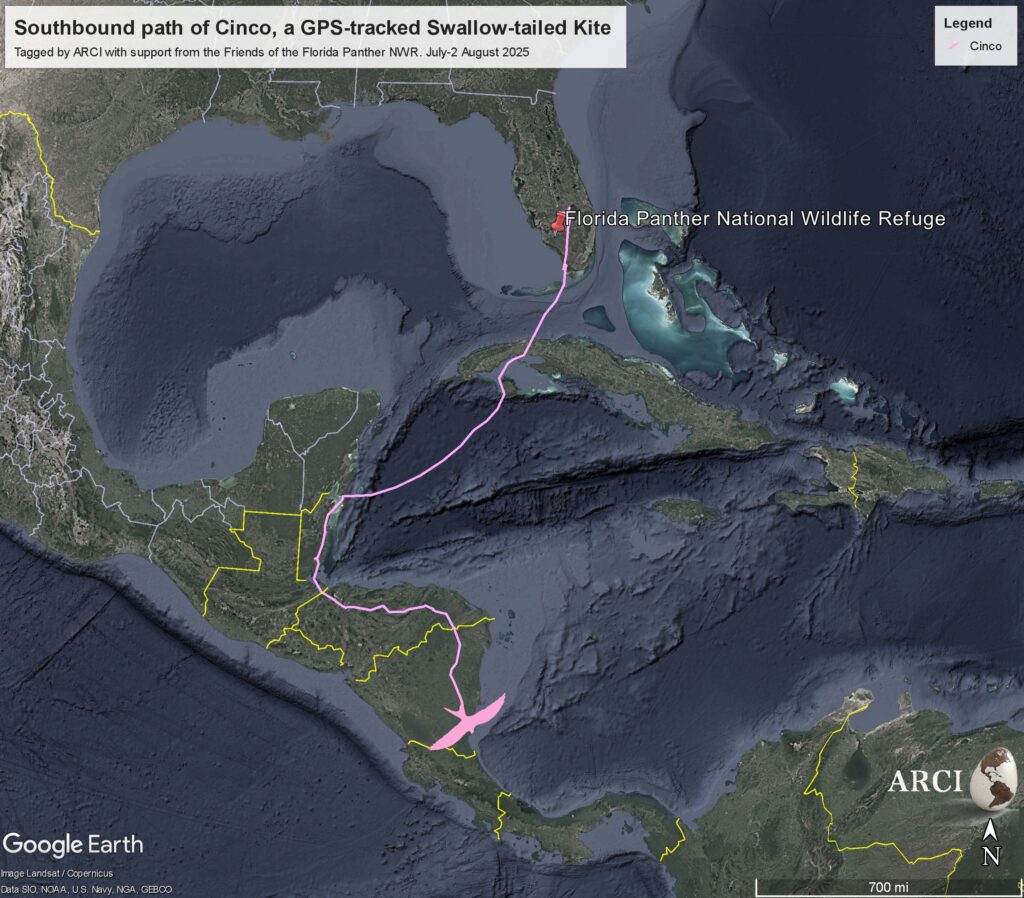
On 21 July, she moved south, almost crossing Florida Bay at 6:30 pm, but made the better choice to spend the night in the Everglades National Park. At 9:30 am the next morning she flew due south, just west of Marathon in the Florida Keys and straight to Cuba. She flew through the country and by dark roosted on a small group of islands south of Guanimar, Cuba.
Early on the morning of 23 July, she skirted southwest around Isla de Juventud, flying through the night and all the way to southern Quintana Roo, Mexico, arriving about 24 hours later. This was a non-stop flight from Cuba to an area in southern Belize called Waha Leaf Camp, where she rested for three days before continuing through Central America.
She is making continual southerly progress and last reported from Las Breñas, Nicaragua on 2 August 2025.
Cinco is being tracked by the GSM-cellular network thus, when she is not near cell towers, she cannot upload data. She only attempts to upload data once a day to save battery on the solar-powered unit (by CTT). During long stretches over mountains, rainforest, and vast wilderness, she can be far from a cellular connection. Once she reaches a place with cell coverage, she will be able to connect and upload all the location data.
Cinco’s tracking is generously supported by The Friends of the Florida Panther Refuge, with logistical support from the staff at the Florida Panther National Wildlife Refuge.
**All Swallow-tailed Kites are captured, banded, and tagged with current federal, state, and local permits.
Wow so glad she made it and had a successful season, I have wondered about her all summer.
Thank you for the update and all the work that you all do, really enjoy you site.
Looking forward to next year.
Appreciate it, thank you! She’s a resilient bird. Ready to do it all over again!