
In the summer of 2025, ARCI was fortunate to receive funds and support from the Merritt Island Wildlife Association, West Volusia Audubon, and the Lake Woodruff National Wildlife Refuge to capture and track an adult female Swallow-tailed Kite near the Refuge. Her location data will be combined with data from many other GPS-tracked Swallow-tailed Kites from across the southeastern States to help us understand kite nesting areas, roost sites, foraging areas, stopover sites, and winter destinations.
We named the kite Astor because she was captured near the town of Astor. From early June in to July, she foraged and roosted along the St. Johns River in parts of Volusia and Lake County near her nesting area. After her chicks presumably fledged, she flew south to stage and feed copiously to put on weight and get ready for migration.
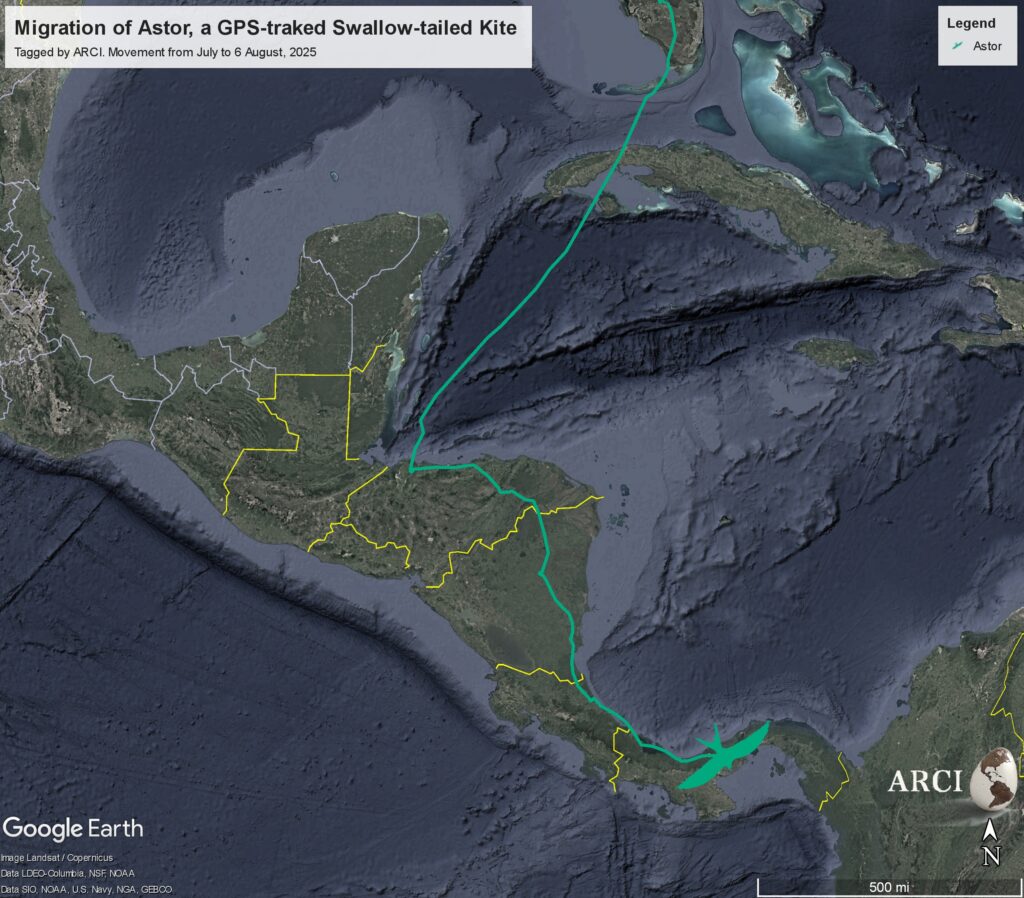
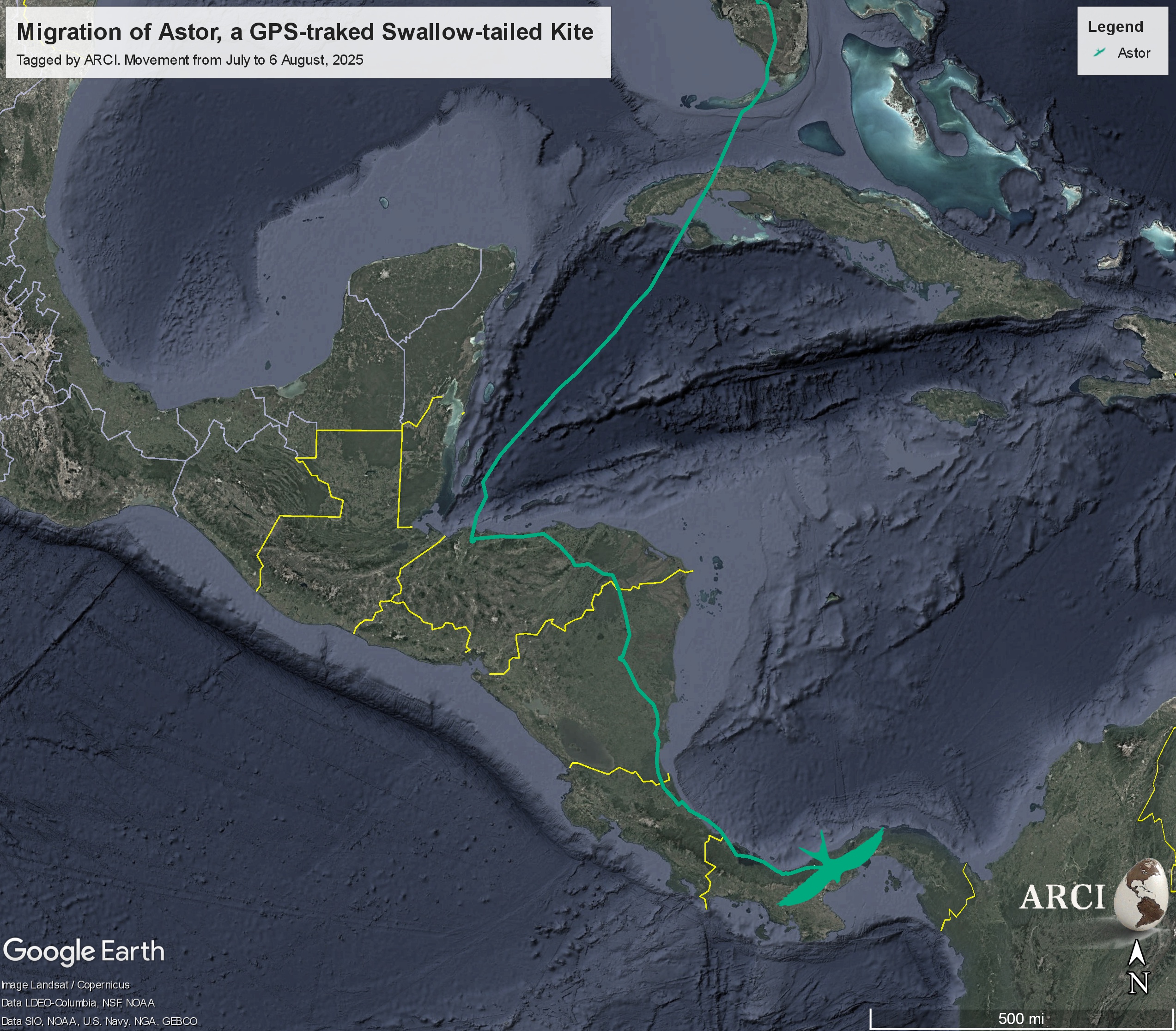
On the morning of 27 July 2025 Astor started on her southbound journey from Glades County. She had great tailwinds, taking her from the Everglades, across the Florida Keys and the Straights of Florida to Cuba where she spent the night near San Antonio de los Banos. She flew over 300 miles that day.
On 28 July, she continued south southwest flying all day and night, bypassing the typical migrating kite target of the Yucatán Peninsula, and finally made landfall in Honduras after flying more than 600 miles over open ocean! While most Swallow-tailed Kites typically arrive in Mexico’s Yucatán Peninsula and continue south overland through Central America, Astor took a risky shortcut to Honduras but was aided by good tailwinds.
Each day since, she has made southerly progress, over land now instead of water, through Central America. On 8 August, her transmitter was finally able to connect with cell towers near Boca de Cuiria, Panama to transmit the exciting data about her extraordinary journey.
Wishing all Swallow-tailed Kites great tailwinds for a safe migration!
Check in again, as we will be sharing updates on kite migration to South America. Meanwhile, the 2025 Swallow-tailed Kite population monitoring survey period is now. We hope you will report where you are seeing kites to add “your” kites to the U.S. population count. That form can be found here.
*All captures, banding, and tagging of Swallow-tailed Kites are done safely under current federal, state, and local permits.
Leave a Reply