
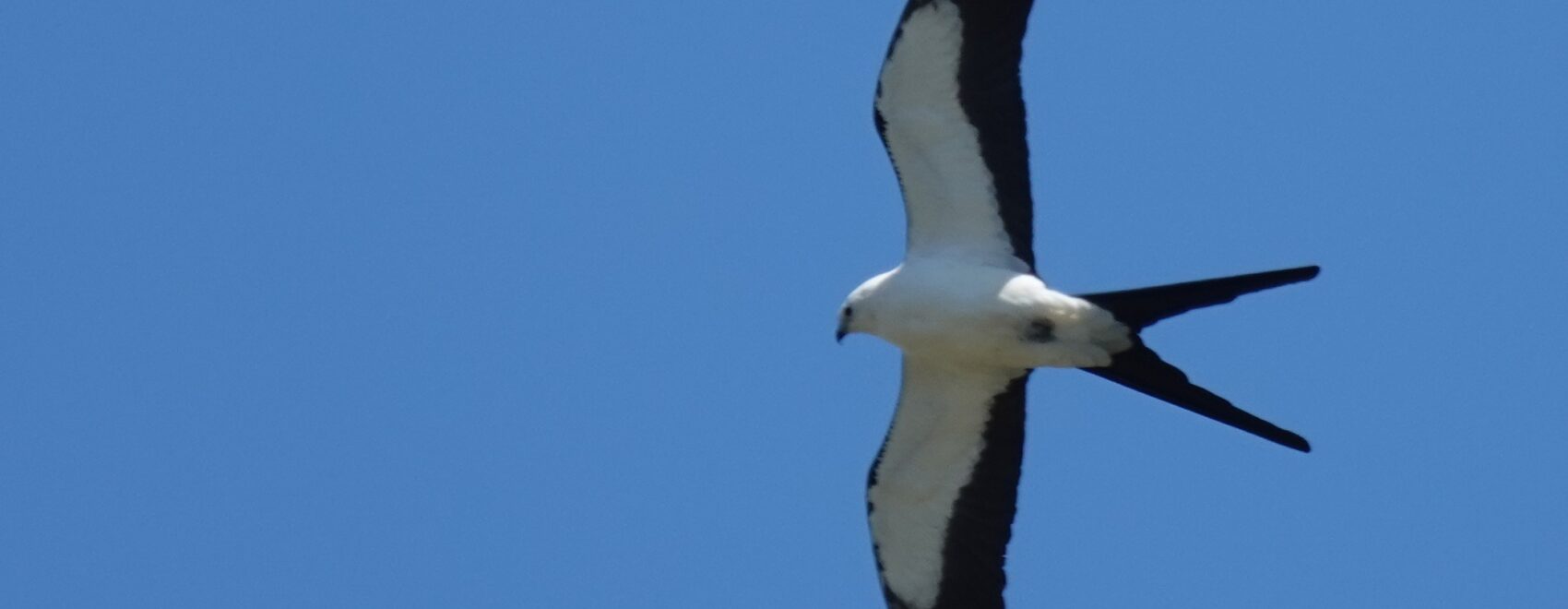
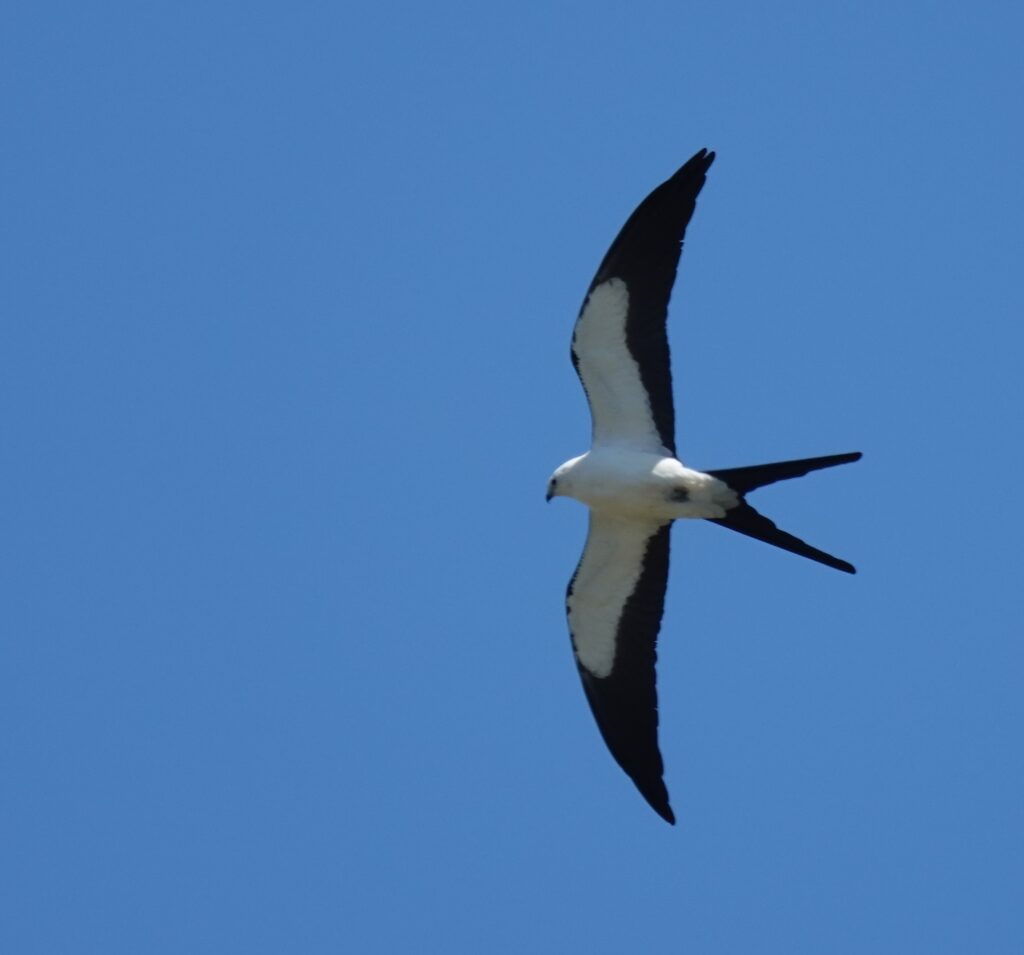
ARCI, together with Orleans Audubon Society, have been tracking Swallow-tailed Kite migration since the 1990s. We are always amazed as the flight paths of these kites unfold as they approach their breeding areas. Migration is risky and can be deadly. Many species like the Swallow-tailed Kite have long, potentially dangerous, over-water crossings where they cannot get food or land to rest.
All banding and tagging was done by the Avian Research and Conservation Institute and Orleans Audubon Society under federal and state banding permits.
Where is our Aerial Research Team now?
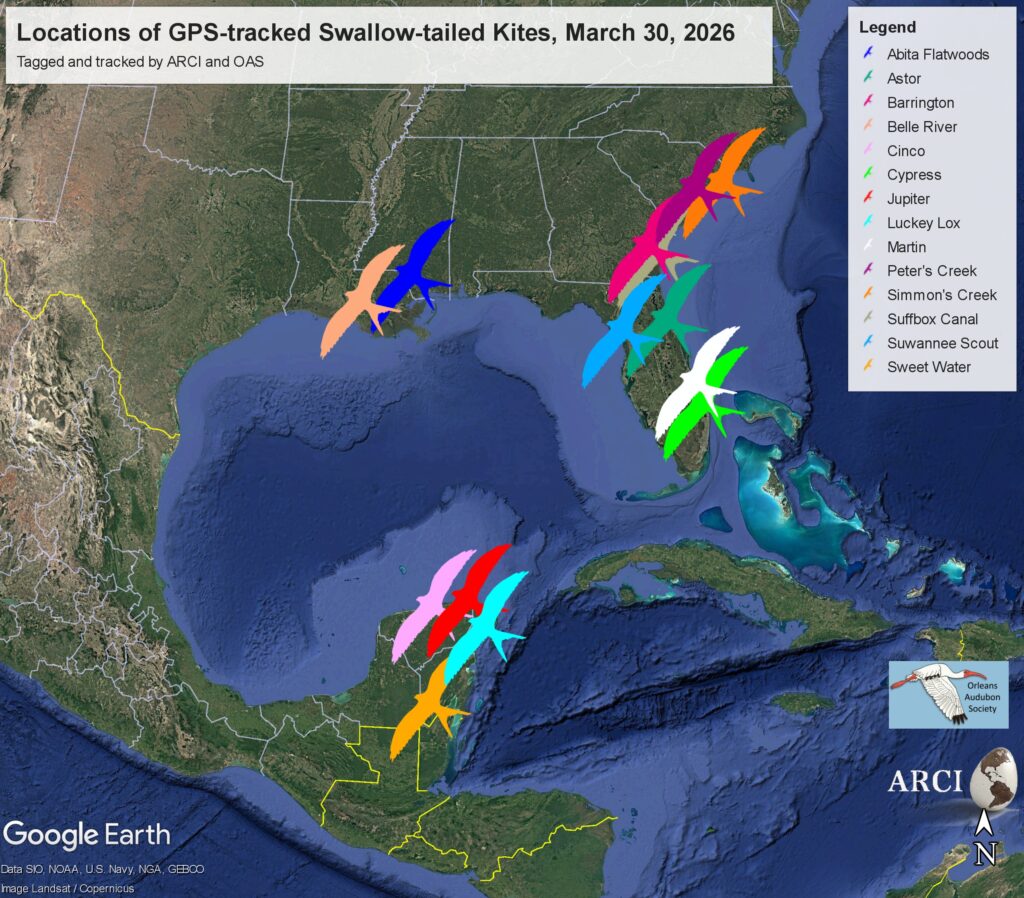
Many of the GPS-tracked Swallow-tailed Kites have arrived at their territories in the Southeastern U.S.
From north to south: In South Carolina, Peter’s Creek arrived at the Georgetown area two weeks ago, prior to Simmon’s Creek who arrived on 28 March.
In Georgia, Snuffbox Canal has been on territory since 13 March. Barrington arrived on 27 March following a 9-day rest in Alabama after a long over-water crossing.
In north Florida, Astor returned to Lake County and Suwannee Scout is back on the Lower Suwannee National Wildlife Refuge.
Two Palm Beach County Swallow-tailed Kites have also returned to their breeding grounds.
In Louisiana, Belle River returned but has not uploaded data since 14 March. We are anxious to “hear” from her again soon. Abita Flatwoods struggled to stay on course across the Gulf to Louisiana but was carried east to Dixie County, Florida where she rested for six days prior to heading north over land back to her breeding area.
In Mexico’s Yucatán, we are most concerned about Luckey Lox from Palm Beach County, Florida that has not uploaded data since 28 February. Similarly, Jupiter, also from Palm Beach County, last reported from the Yucatán on 15 March and Cinco, a female from Collier County, Florida last reported on 19 March. By now they all should have uploaded data from the U.S. but they may have succumbed to poor weather and strong headwinds preventing them from reaching land. We are hopeful that each of them was carried by the wind to remote areas where they are resting and that we will get data from them again.
Sweet Water from Burke County, Georgia recently uploaded data in Belize on her northbound migration after a few months of radio silence while she crossed through remote areas. We hope she will time the winds right for a safe Gulf crossing.
Join us for the screening of “Tracking Kites” a film about kite research and our cooperation with ERM and the Palm Beach Zoo and Conservation Society. The film was created by Palm Beach County’s Department of Environmental Resources Management (ERM) and directed by ERM’s Benji Studt. There will be a special showing of the film on April 10th at the Jupiter Inlet Lighthouse. See details here:
https://www.facebook.com/share/v/18FQjkpQEu
And get your tickets here: https://64862.blackbaudhosting.com/64862/tickets?tab=2…
Keep your eyes to the skies and share your kite sightings with us:
If you are seeing nesting behavior and want to assist ARCI with nest monitoring, please join Eyes on Kites:
This work would not be possible without our dedicated supporters and collaborators. For our current GPS-tracked Swallow-tailed Kites we thank:
American Bird Conservancy (ABC)
The Avian Reconditioning Center for Birds of Prey
Barataria-Terrebonne National Estuary Program
Cellular Tracking Technologies CTT GSM-GPS transmitters
Florida Ornithological Society
Florida Panther National Wildlife Refuge
Friends of the Lower Suwannee & Cedar Keys National Wildlife Refuges
Friends of the Florida Panther National Wildlife Refuge
Lake Woodruff National Wildlife Refuge
Lower Suwannee National Wildlife Refuge
McDaniel Charitable Foundation
Merrit Island Wildlife Association
Microwave Telemetry, Inc. Satellite transmitters
National Fish and Wildlife Foundation
Ornitela GSM-GPS transmitters
Palm Beach County Department of Environmental Resources Management
Palm Beach Zoo and Conservation Society
Parkside Elementary School, Collier Co. Florida
Sanibel-Captiva Audubon Society
Leave a Reply