
ARCI is researching Swallow-tailed Kites in Palm Beach County, Florida through a partnership with the Palm Beach County’s Department of Environmental Resources Management (ERM) and the Palm Beach Zoo & Conservation Society. A recent highlight of this partnership is the creation of the film “Tracking Kites” produced by ERM and directed by Benji Studt. You can join us for a special screening at the Jupiter Inlet Lighthouse on April 10th and/or 11th 2026 at the Wild and Scenic Film Festival. See here for information, tickets and the film trailer:
https://www.facebook.com/reel/974047898384942
For those on Florida’s west coast, there will be a screening of “Tracking Kites” on 4:00 pm on 11 April 2026 at the Florida Birding and Nature Festival at Apollo Beach: https://www.floridabirdingandnaturefestival.org/schedule.html
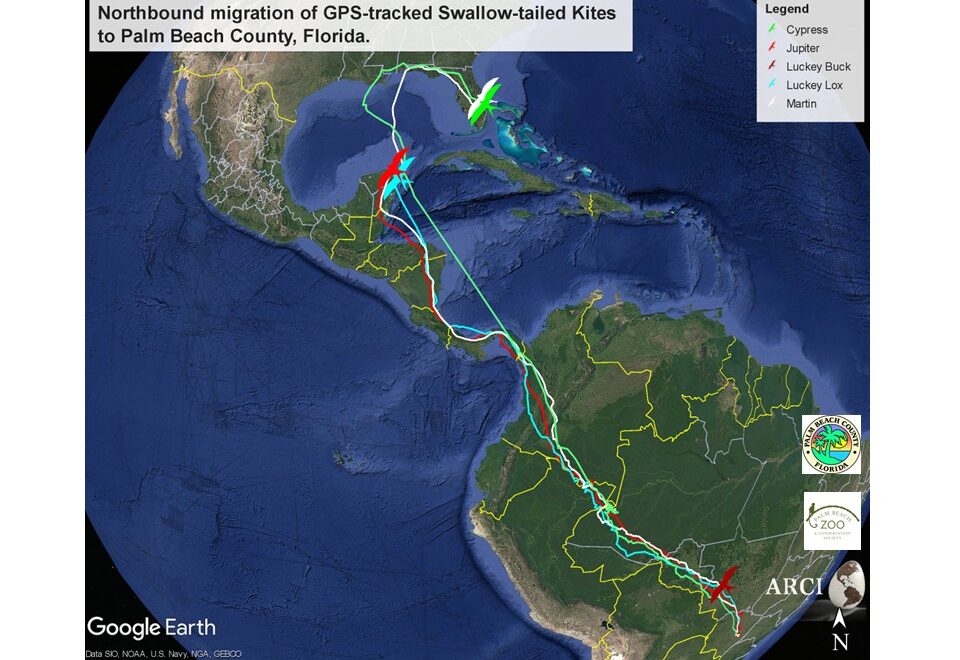
The GPS-tracked Swallow-tailed Kites that are part of this collaboration are migrating back to Palm Beach County, Florida. Two of them, Cypress and Martin, have returned to their nesting territories after a 5,000-mile migration from Brazil.
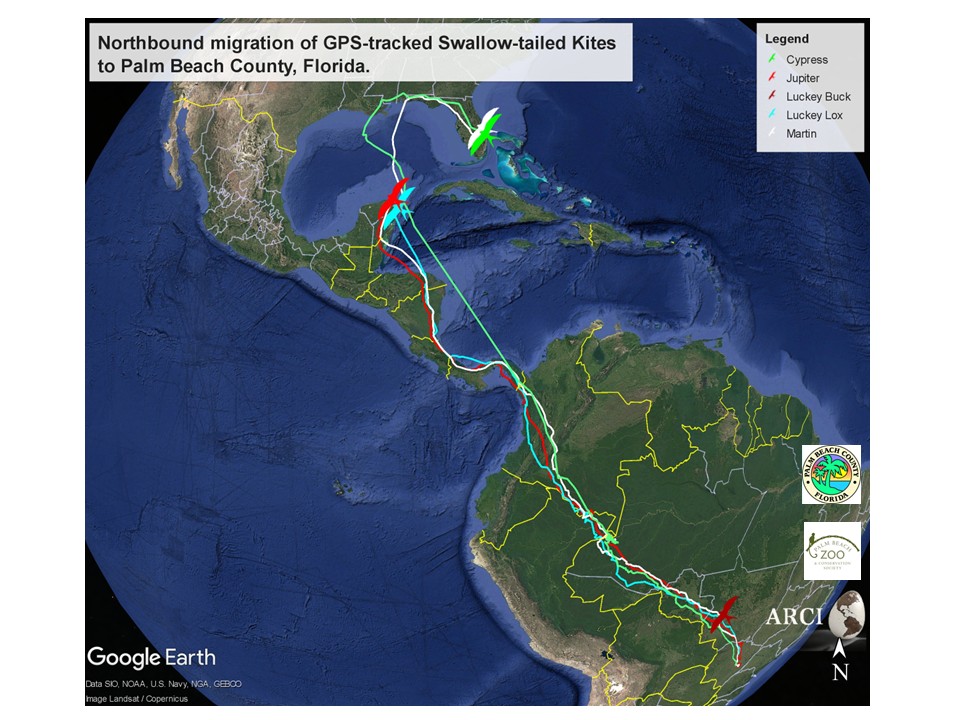
Cypress, a male tagged in 2023, was the first Swallow-tailed Kite to return to Palm Beach County. He flew across the Gulf on 1 March where the wind pushed him westward, putting him in Louisiana 35 hours later. He followed the coast east through the Florida Panhandle then south through the Peninsula back to Palm Beach County by 9 March.
Martin, a male tagged in 2025, followed Cypress’s trek a week later, leaving the Yucatán on 8 March and arriving after 35 hours near Pensacola, Florida. By 16 March, he, too, was back on territory in Palm Beach County. Martin’s story is significant because his tracker did not upload any location data since August 2025, thus it was a big surprise to “hear” from him once again. His tracker had recorded and stored all the GPS data while he was traveling through Central and South America and when he was able to connect with a cell network again, all that data was downloaded so we could see where he had been.
Luckey Lox, a female tagged in 2023, last reported from the Yucatán Peninsula on 28 February. Her transmitter has not sent a signal since then. During this time there were cold fronts and harsh headwinds moving across the Gulf, exactly in the direction of her expected route to Florida. She may have left only hours before Cypress, but if she varied her route slightly from his, she could have encountered deadly headwinds preventing her from reaching land. We are hopeful that she was carried by the wind to a remote area where she is resting and that we will get data from her again.
Jupiter, a female tagged in 2025, arrived in the northern Yucatán on 15 March and last reported there on 22 March. Winds had not been favorable for several days, and she played it safe and didn’t attempt to embark on the risky over-water segment of her journey. However, on 22 March, she found a window of better weather and attempted the flight. Unfortunately, we have not received data since then. Did she make it to a remote area without a cell service, so her transmitter was unable to send a GPS-location update? We are sitting on pins and needles with our fingers crossed!
Luckey Buck, a male tagged in 2025, was Luckey Lox’s mate in 2025. We have been without contact from Luckey Buck since 25 October when he was heading south through Mato Grosso do Sul, Brazil. Many Swallow-tailed Kites are still in route to the U.S., so there is time to be surprised by a data upload from Luckey Buck.
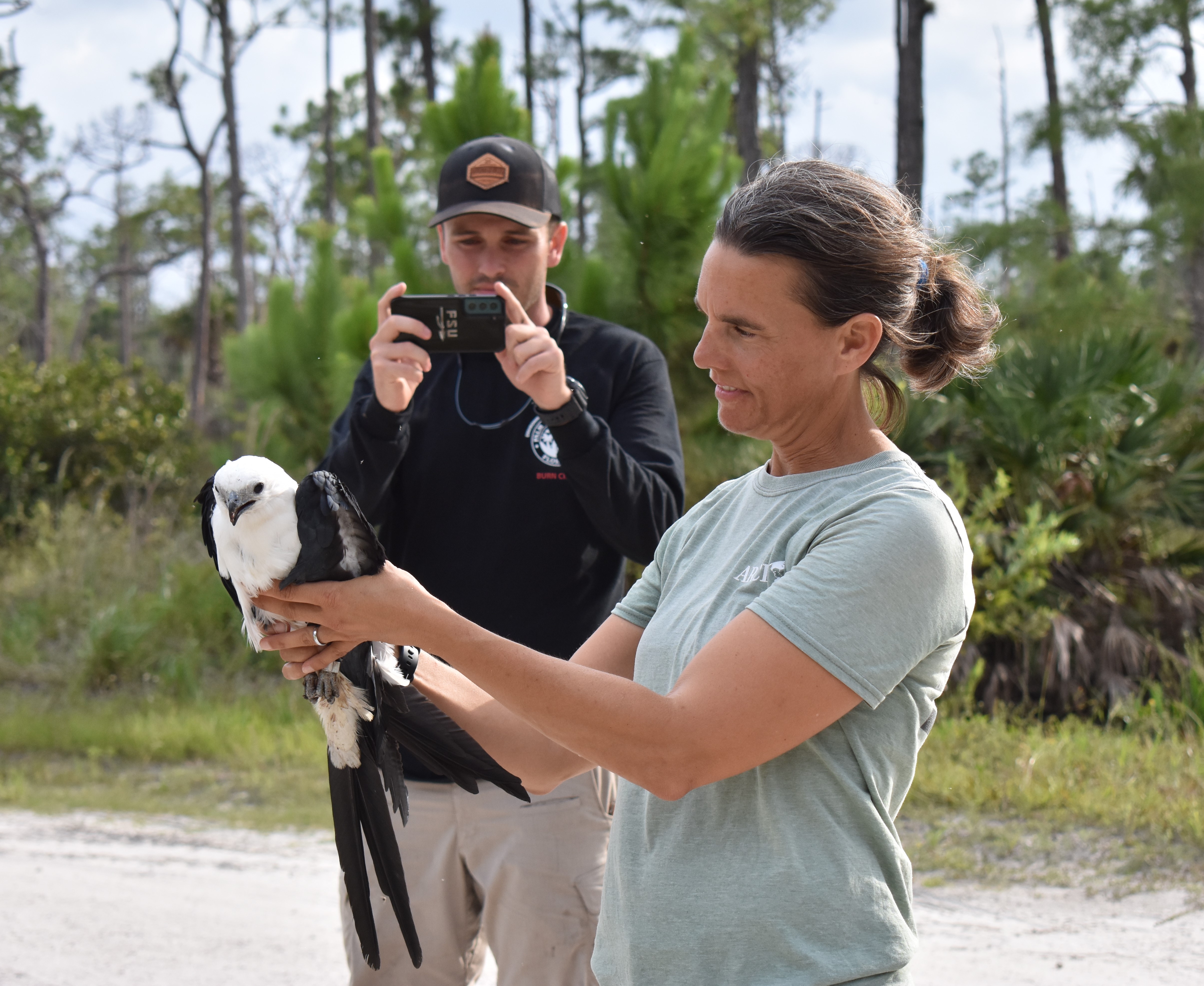
ARCI tracks Swallow-tailed Kites not only to monitor the roosts, foraging areas, stopover sites, and winter destinations, but also to see how they use public and private lands, and how they survive throughout the Southeastern States. We are grateful for our funders and project partners for making this research possible.
Palm Beach Zoo & Conservation Society, in conjunction with long-time Zoo sponsor Florida Power & Light Company, have generously provided funding for the solar-powered GSM-GPS transmitters needed to continue this vital conservation effort.
You can report kite sightings here:
And if you see nesting activity, become part of our Eyes on Kites nest monitoring team, join and report sightings here:
All banding and tagging is done by the Avian Research and Conservation Institute under the current federal, state, and local banding permits.
Im observing a nesting pair behind my home. Im not sure if they have eggs. Today I saw one of them bring a piece of nesting material and also saw a lizard in one their beak.
Wow, how lucky to have kites so close to you! We have a nest watching program that you could help us with my sending us updates on the nesting kites. You can sign up and register your nest here: https://www.arcinst.org/eyes-on-kites/
Thanks!
Why did these birds specifically go to the same locations in Florida and South America?
Good question. They have strong site fidelity and will return to places that they have had luck in nesting and feeding.