
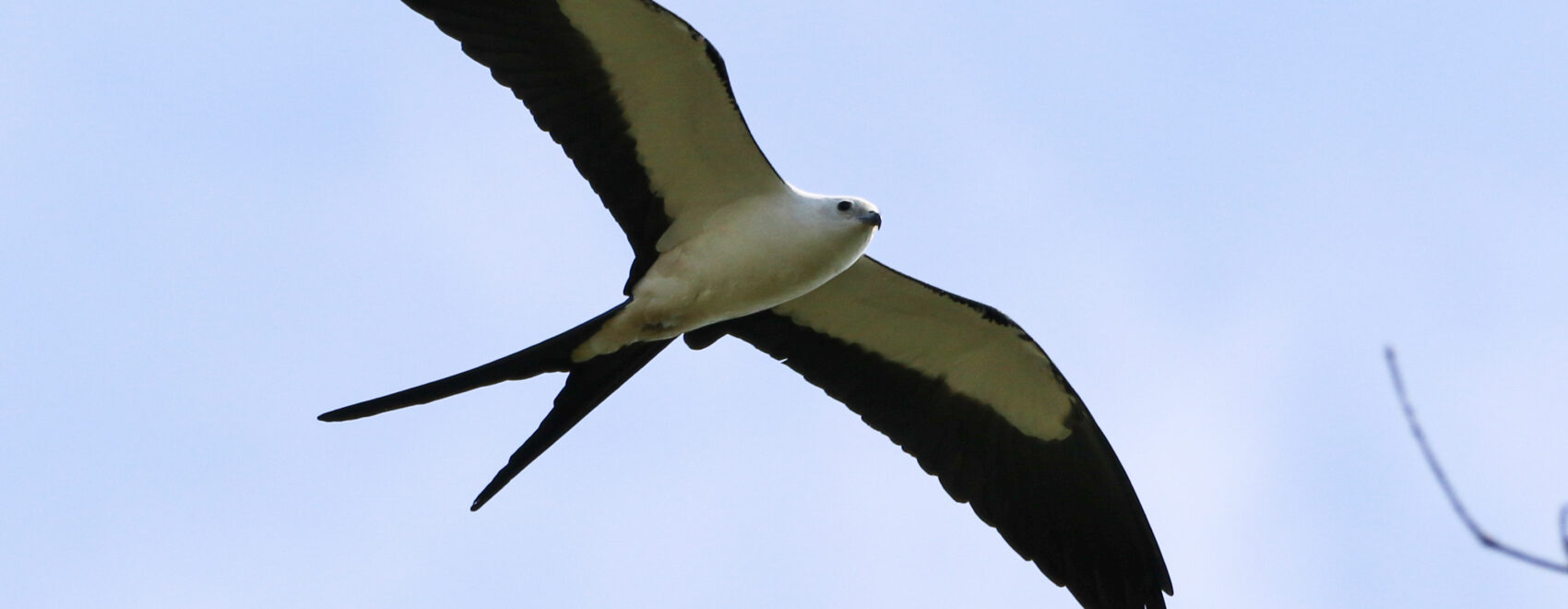
ARCI and Orleans Audubon Society (OAS) are tracking Swallow-tailed Kites not only to monitor the roosts, foraging areas, stopover sites, and winter destinations, but also to see how they use public and private lands throughout the Southeastern States. We are grateful for our funders and project partners for making this research possible.
Below is the migration update for August 20, 2026. Where are they now??
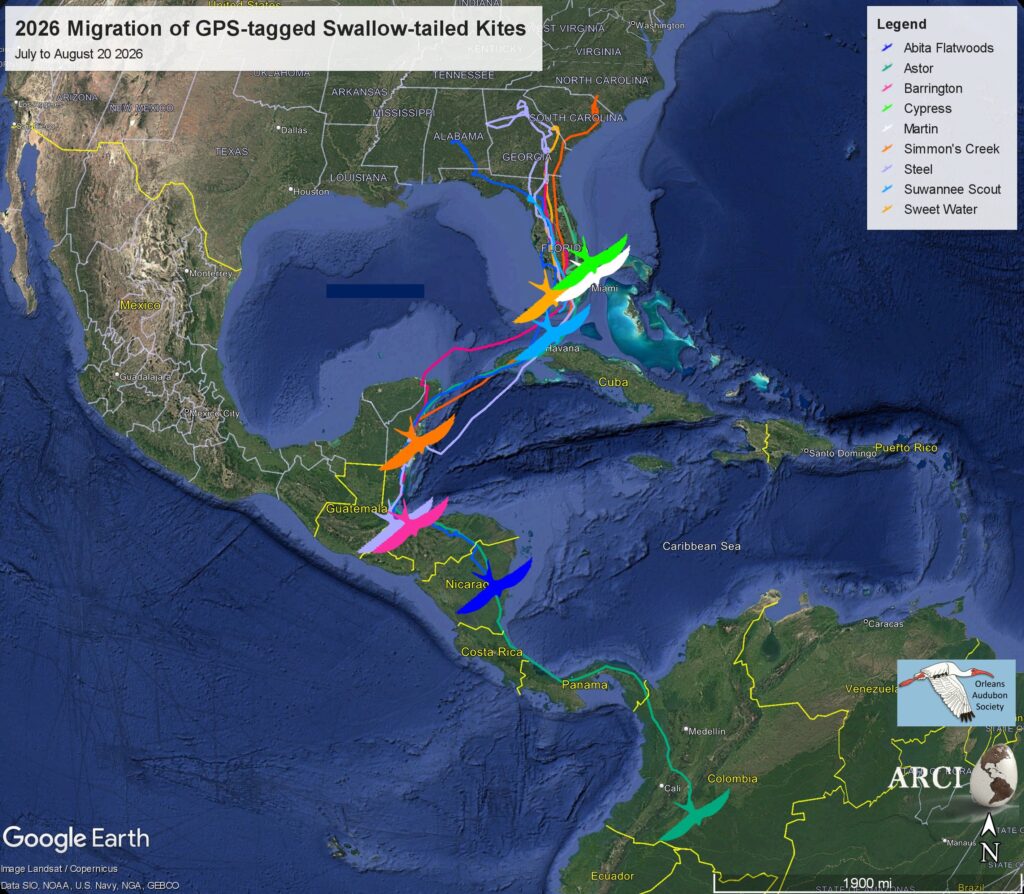
Astor: Female, tagged in 2025, from Lake County, Florida was the first kite to leave and is the farthest from Florida, already safely crossed the Andes Mountains in Colombia. She left from the Florida Everglades straight across to Cuba on 30 July. After one night on Cuba she flew to Mexico just south of Cancún.
Abita Flatwoods: Female, tagged in 2023 in St. Tammany Parrish, Louisiana by OAS. After the nesting season, Abita Flatwoods found her way to foraging and roosting spots in Alabama where she spent over a month getting fit and ready to migrate. She flew south to Florida and on 7 August she flew due south from Marco Island, Florida to Cuba. Like Astor, she also spent one night on the Island and then crossed the Caribbean landing just south of Cancún, Mexico. Her most recent location was in Nicaragua.
Suwannee Scout: Male, tagged in 2025, from Levy County, Florida. Although he did not nest in 2026, he spent the summer and pre-migration period within the Lower Suwannee NWR and along the Suwannee River. His southbound push occurred on 10 August and he was over the Straights of Florida on 12 August. We have not received data from him since he started across the open ocean. We hope he made safe landfall and we’ll get a cellular update soon.
Barrington: Male, tagged in 2023, from McIntosh County, Georgia spent pre-migration on the Altamaha River and started south through Florida on 6 August. On 10 August he flew southwest from the Everglades directly to the northern Yucatan Peninsula in 22 hours. He slowed down through the Yucatan, and his last location was in Honduras.
Sweet Water: Female, tagged in 2024, from Burke County, Georgia, spent the summer and pre-migration on the Savannah River. She started south on 6 August and moved through Florida quickly. On 11 August she last reported from the southern Everglades. We have not received data from her since she started across the open ocean but hope to get a cellular update soon.
Simmon’s Creek: Male, tagged in 2023, from Georgetown County, South Carolina, spent the pre-migration period on the Great Pee Dee River in South Carolina. He started south on 8 August, leaving the Florida Everglades on 13 August. After one night in Cuba, he safely made it to Mexico and spent four days in the Sian Ka’an Biosphere Reserve.
We welcome Steel to our migrating class of 2026. Steel, a female, was tagged in 2026 in McIntosh County, Georgia. Nesting and trapping locations were monitored and located by Georgia Department of Natural Resources staff. Funding and support for her tag comes from ARCI’s partnership with the American Bird Conservancy (ABC), International Paper (IP) and OAS for a project investigating Swallow-tailed Kites’ use of working forests in the Southeast. Steel had the most extensive pre-migration movements of all of the kites. She flew north of Athens Geogia and then flew a two-day loop through north central Florida. When she was ready to head south, she cruised through Florida and was crossing the Straights of Florida on 12 August. After spending one night in Cuba she arrived in Mexico on 14 August. She last checked in from Honduras, one day later than Barrington.
Two males from Palm Beach County, Florida: Cypress tagged in 2022, and Martin tagged in 2025 are both still in Palm Beach County.
We had some unexpected tragedies at the end of the breeding season when two of our breeding male GPS-tagged kites were presumably hit by vehicles. First, Peter’s Creek, tagged in 2021, from Georgetown, South Carolina was found only a few miles away from his breeding territory. He was the oldest-tagged Swallow-tailed Kite we were following. The other potential loss was Snuffbox Canal, tagged in 2023, from McIntosh County, Georgia and hit on I-95. Unfortunately, Swallow-tailed Kites naturally follow corridors, and sometimes these include roadways. Often the large trees on either side of the road create good foraging opportunities and access to prey on the edge of the forest. Also, these roads cross through fields and marshes where abundant insects could be swarming. In pursuit of these flying insects, a kite could lose sight of fast-moving dangers.
Finally, Cinco a female, tagged in 2023 from Collier County, Florida last reported from south Florida on 1 August where she had been in a communal roost for over a month. We assume she crossed the Gulf on this day but we had hoped to get an update from her by now. We still may, and it could be that we don’t get data until she returns in the spring. We will keep hopeful.
Please note: All captures, banding, and tagging of Swallow-tailed Kites are done safely under current federal, state, and local permits.
Most of these Swallow-tailed Kites are being tracked through the GSM-cellular network thus, when they are not near cell towers, they cannot upload their data. The transmitters only attempt to upload data once a day to save battery power. These solar powered units are made by Cellular Tracking Technologies and Ornitela. During long distances over mountains, rainforest, and vast wilderness, they are far from a cellular connection. The location data is stored until they are within cell range and can upload the data.
Wishing all Swallow-tailed Kites great tailwinds for a safe migration!
This work would not be possible without our dedicated supporters and collaborators. For our current GPS-tracked Swallow-tailed Kites we thank:
American Bird Conservancy (ABC)
The Avian Reconditioning Center for Birds of Prey
Barataria-Terrebonne National Estuary Program
Cellular Tracking Technologies CTT GSM-GPS transmitters
Florida Ornithological Society
Florida Panther National Wildlife Refuge
Friends of the Lower Suwannee & Cedar Keys National Wildlife Refuges
Friends of the Florida Panther National Wildlife Refuge
Georgia Department of Natural Resources
Lake Woodruff National Wildlife Refuge
Lower Suwannee National Wildlife Refuge
McDaniel Charitable Foundation
Merrit Island Wildlife Association
Microwave Telemetry, Inc. Satellite transmitters
National Fish and Wildlife Federation
Ornitela GSM-GPS transmitters
Palm Beach County Department of Environmental Resources Management
Palm Beach Zoo and Conservation Society
I saw 3 Swallow-tail kites August 11 around noon in Lumpkin County in northeast Georgia
Please inquire for more info, pictures
Awesome! Thanks for your sighting report.
Enjoyed reading this information. Love catching sight of these birds around Bartow, FL.
Thanks for reading! We feel fortunate to be able to track these long-distance traveling birds.
Do we know why some head straight south, whereas others wander up north. We have 5 here just south of Lexington, KY. This is quite the number when we on get a couple every now and again.
Pretty cool! Swallow-tailed Kites are proficiant fliers and will often go where the wind takes them. After breeding some adults and fledged birds travel far and wide in all directions, checking on different places with an abundance of insects. If a kite has luck at finding good insect prey, it may return to those areas in future years. And perhaps, it may bring other kites along.